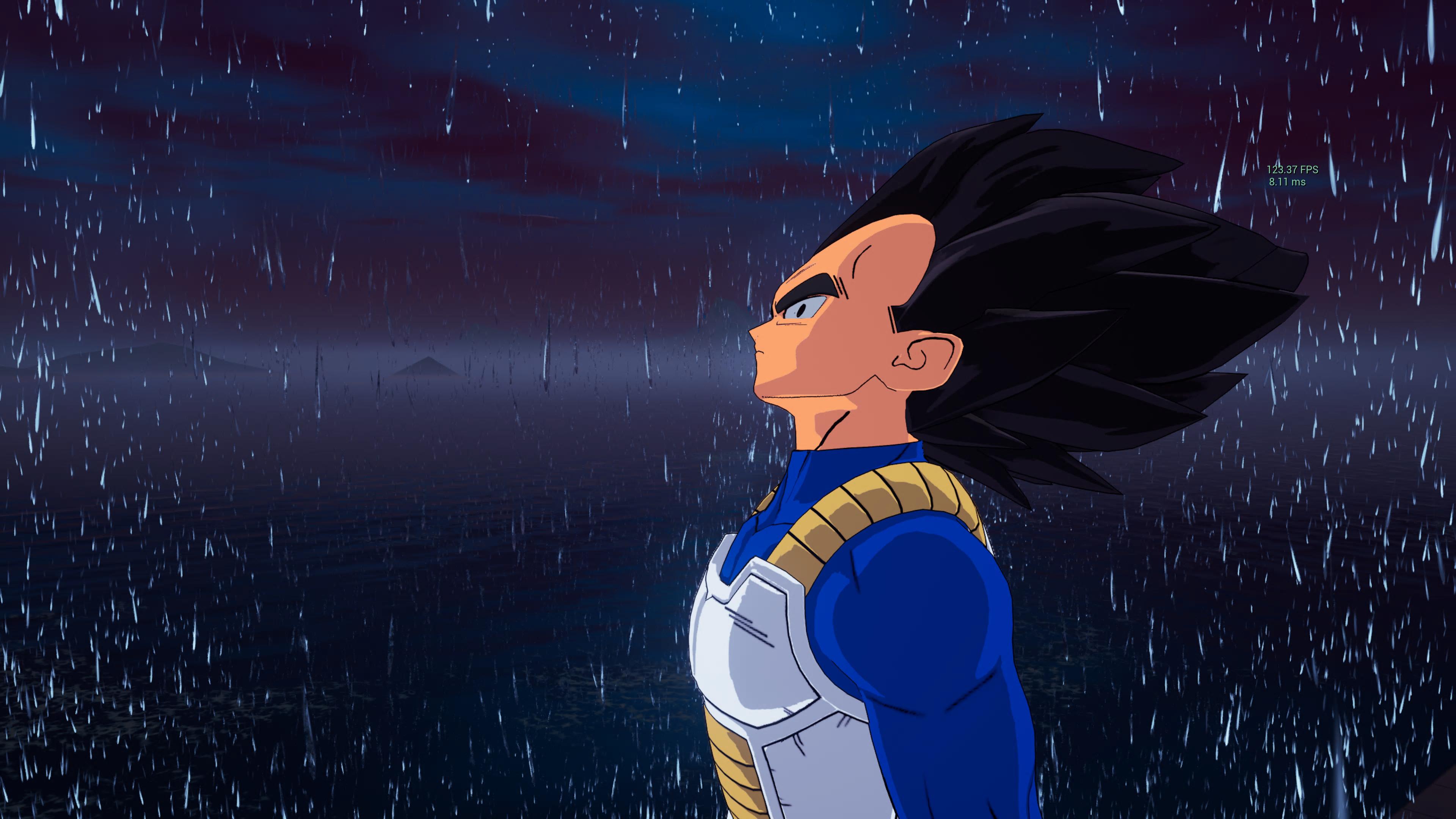
He’s standing there. Just standing. Water is sheeting off his armor, his hair is matted down for once, and there isn't a single line of dialogue. If you grew up watching Dragon Ball Z, you know the exact frame. It’s the "Vegeta in the rain" moment. It’s been turned into a million lo-fi hip-hop thumbnails and gym motivation posters, but there’s actually a lot of heavy lifting happening in that scene that most people gloss over. It isn't just about a cool aesthetic or a "hard" edit. It’s the peak of Akira Toriyama’s character writing, captured in a single, miserable atmosphere.
Honestly, it’s kinda weird how much this specific trope resonates. We see it during the Android Saga, specifically when Vegeta realizes he’s hit a wall. He’s the Prince of All Saiyans, right? He’s supposed to be the best. But then Goku hits Super Saiyan first. Then Trunks shows up and does it. Then Vegeta finally achieves it, only to get his arm snapped by Android 18. That’s when the rain starts. It’s a literal and figurative cold shower for his ego.
The Narrative Weight of Vegeta in the Rain
When we talk about Vegeta in the rain, we are usually referencing the aftermath of his defeat by the Androids or his solitary training sessions on distant planets. There’s a specific sequence where he’s out in a storm, staring into the middle distance. It’s visceral. In the original Japanese broadcast and the subsequent Funimation dubs, the sound design shifts. The loud, aggressive Bruce Faulconer score or the synth-heavy Japanese tracks often fade out, leaving just the white noise of the downpour.
This isn't just filler. In visual storytelling, rain is often used for "pathetic fallacy"—where the environment reflects the character's internal state. Vegeta is a character defined by fire, pride, and heat. Seeing him drenched and cooled down suggests a total loss of power. He’s vulnerable. You’ve got this guy who can blow up a planet with a finger, yet he’s just letting the weather beat him down. It’s a moment of forced reflection that changed the trajectory of the series. Without these moments of quiet "rainy" despair, his eventual sacrifice against Majin Buu wouldn't have felt earned. It’s the buildup.
Why the "Sad Vegeta" Aesthetic Took Over the Internet
You can’t go on TikTok or Instagram without seeing a slowed-down version of this scene. Why? It’s basically the universal symbol for "the grind." People see Vegeta in the rain and they don't see a cartoon character; they see themselves after a bad breakup or a failed job interview. It’s the "lonely at the top" vibe, even though at that point in the story, Vegeta wasn't even at the top. He was arguably at his lowest.
The internet has a way of stripping away the context and leaving the raw emotion. There’s a specific "mood" here. It’s melancholic. It’s isolated. Most shonen protagonists get a "power of friendship" speech when they lose. Vegeta gets a storm. He doesn't have a support system. He doesn't have a Bulma or a Trunks he’s willing to lean on yet. He just has the rain. That’s why it hits different for people who feel like they have to handle their problems alone.
The Technical Artistry of the Android Saga
If you look at the animation cels from the early 90s, the way they handled the Vegeta in the rain scenes was actually pretty sophisticated for the time. They used multiple layers of cel animation to create the illusion of depth in the rainfall. It wasn't just white lines drawn over the characters. There’s a certain shimmer to the way the water hits his blue spandex and the white chest plate of his battle armor.
- Color Palette Shifting: Notice how the vibrant blues and yellows of the Super Saiyan form are muted. Everything becomes grey, navy, and charcoal. This visual "muting" forces the viewer to focus on Vegeta's eyes.
- Line Work: The artists often added more detail to the facial lines during these scenes to emphasize exhaustion.
- Pacing: These scenes are notoriously slow. In a show known for 100-mph punches, the stillness of the rain is jarring. It creates a vacuum of tension.
Misconceptions About the "Rain" Scene
People often confuse different scenes. There’s the training scene on the rocky planet where he’s trying to go Super Saiyan for the first time—that’s often associated with lightning and storms. Then there’s the post-Android 18 fight where he’s just brooding. Fans often mash these together in their heads.
Another big misconception is that Vegeta is "giving up" in these moments. He isn't. If you actually watch the progression of the series, the rain scenes usually precede a massive jump in power. It’s the "quiet before the storm" trope used literally. He’s processing the trauma of his inferiority complex. It’s arguably the most human he ever looks. He isn't a god or a warrior king in the rain; he’s just a guy who realized he isn't as good as he thought he was. That realization is what eventually makes him a better person, but in the moment, it just sucks.
How to Apply the "Vegeta Mindset" (The Healthy Way)
If you’re one of the thousands of people who use Vegeta in the rain as your phone wallpaper, there’s a practical takeaway here. The scene isn't about wallowing. It’s about the necessity of solitude in the face of failure.
- Step 1: Acknowledge the loss. Vegeta doesn't pretend he didn't get beaten. He sits with it. In your own life, don't toxic-positivity your way out of a setback. If you failed, feel it.
- Step 2: Isolate the noise. The rain creates a barrier between him and the rest of the Z-Fighters. Sometimes you need to turn off your phone and just exist with your thoughts to figure out your next move.
- Step 3: Internalize the "Why." During these rainy episodes, Vegeta is usually questioning his motivations. Are you doing things for your own growth, or just to outshine someone else? Vegeta’s obsession with Goku was his downfall; it was only when he started fighting for himself (and later his family) that he surpassed his limits.
- Step 4: Return with a plan. Every time it stops raining in Dragon Ball, Vegeta shows up with a new technique or a higher power level. Use your "rainy" periods to recalibrate.
The image of Vegeta in the rain has stayed relevant for over thirty years because it captures a universal truth: even the strongest people have moments where the world just feels heavy. It’s not a sign of weakness. It’s a part of the process. Next time you see that clip on a "Sigma" edit or a lo-fi stream, remember that it represents the exact moment a villain started the long, painful walk toward becoming a hero.
To dive deeper into the visual history of the series, look for "Dragon Ball Z: Budokai" cutscenes or the "Kakarot" game's recreation of these moments. They offer a modern perspective on how light and weather effects have evolved to tell Vegeta's story without him saying a single word.
Actionable Insights for Fans and Creators:
- For Artists: Study the use of "negative space" in the Vegeta rain scenes. Notice how the background is often simplified to make the character's silhouette more imposing.
- For Writers: Use environmental changes to signal character shifts. Don't just tell the reader a character is sad; make the world feel heavy around them.
- For Personal Growth: Understand that "brooding" is only productive if it leads to an eventual "Final Flash." Don't get stuck in the rain; use it to wash off the old version of yourself.
Vegeta's journey is the heart of the franchise for many, and the rain is where that heart is most exposed. It’s raw, it’s cold, and it’s perfectly human.