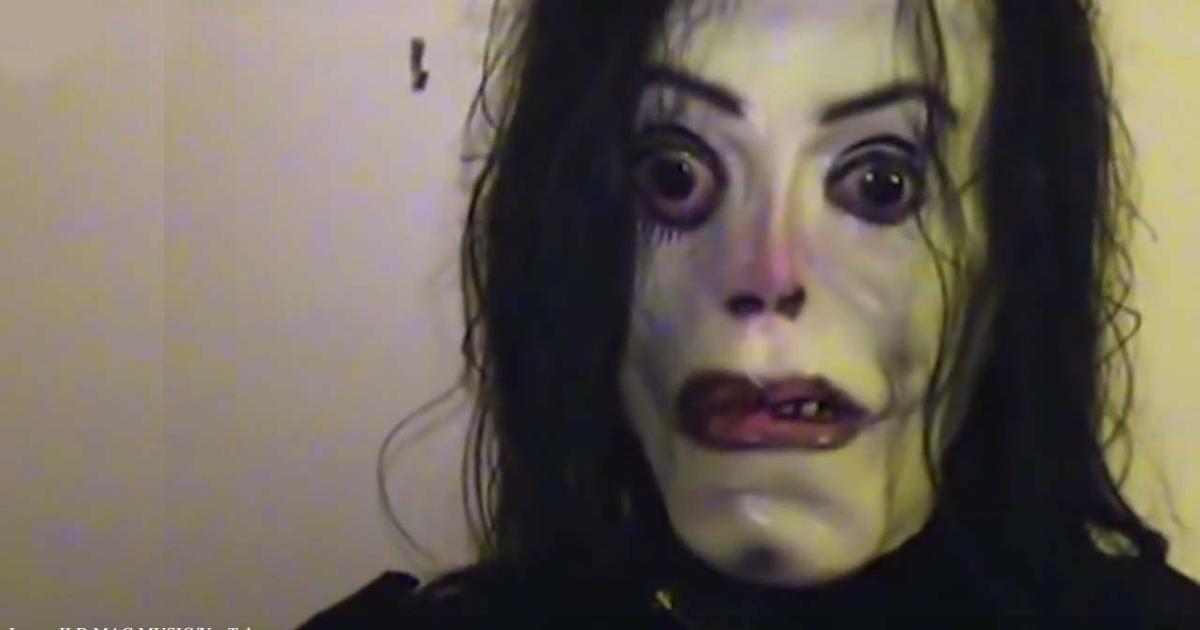
We’ve all seen it. You’re scrolling through a late-night Twitter thread or a niche subreddit, and suddenly, there it is—that distorted, pale, wide-eyed image that people call the scary Michael Jackson face. It’s unsettling. Honestly, it’s more than just unsettling; it taps into a very specific kind of primal "uncanny valley" fear that most of us can’t quite shake. But why does a global pop icon, a man once known for his infectious smile and world-class showmanship, now serve as the template for some of the internet's most effective jump scares?
It’s complicated. It isn't just about one photo.
The "scary" aspect of Jackson’s appearance wasn’t something that happened overnight, and it wasn’t just the result of internet trolls with Photoshop. It was a decades-long transformation played out under the harshest spotlights imaginable. For some, the obsession with his face is a cruel mockery. For others, it’s a genuine fascination with how the human form can be altered until it looks almost alien.
The Evolution of the Image
Let’s be real: Michael Jackson’s face changed more than almost any other person in history. If you look at the Off the Wall era in 1979, he was a handsome young man with natural features. Fast forward to the mid-2000s, and the world was looking at someone who barely resembled that kid from Gary, Indiana. This transition is where the scary Michael Jackson face narrative really took root.
Doctors and biographers, like J. Randy Taraborrelli, have noted that Jackson’s surgeries were often driven by a deep-seated dissatisfaction with his own image, likely stemming from his father Joe Jackson’s verbal abuse about his "fat nose" during childhood. This led to multiple rhinoplasties, a cleft chin surgery, and cheek implants. Combine that with Vitiligo—a real skin condition that destroyed his melanin—and you get a visual profile that the human brain struggles to categorize as "standard."
The internet loves a vacuum, and in the absence of a simple explanation, people filled the gap with creepypasta.
The Rise of "Ayuwoki" and Creepy Memes
If you’ve spent any time on the Spanish-speaking side of the web, you know about the Ayuwoki. This is basically the pinnacle of the scary Michael Jackson face phenomenon. The name comes from a distorted phonetic spelling of the lyric "Annie, are you okay?" from Smooth Criminal. The meme usually features a video of an animatronic Michael Jackson wearing a poorly fitted mask or a highly distorted CGI version of his face.
It’s meant to be a modern-day Bogeyman.
The legend says that the Ayuwoki enters your room at 3:00 AM and screams "Hee-hee!" It sounds ridiculous when you type it out. It’s objectively funny. But the visual itself—the wide, unblinking eyes and the frozen, skeletal nose—triggers that "fight or flight" response. It’s a perfect example of how digital culture takes a real person’s tragedy and warps it into a horror trope.
Why Our Brains React This Way
There’s a scientific reason why we find these images so terrifying. It’s called the Uncanny Valley. This theory, first proposed by roboticist Masahiro Mori in 1970, suggests that as an object looks more human, our empathy for it increases—until it hits a point where it looks almost human but not quite.
That "not quite" part is where the horror lives.
When we look at the scary Michael Jackson face in these memes, our brains see human proportions that are just slightly "off." The nose is too thin. The skin is too translucent. The eyes are too large. Our subconscious registers this as a potential threat or a sign of illness, causing a visceral reaction of disgust or fear. It’s not necessarily about Michael the person; it’s about the geometry of the image itself.
The Role of Lighting and Low-Quality Media
A lot of the "scariest" photos of Michael Jackson weren't professional shots. They were paparazzi photos taken with high-intensity flashes in the middle of the night. If you take a photo of anyone with a direct flash at 2:00 AM while they are moving, they’re going to look a bit like a ghost.
For Jackson, whose skin was exceptionally pale due to his condition and treatments, these flashes washed out all his natural contours. It left him looking flat and two-dimensional, like a porcelain mask. When you see those images today, usually compressed through ten layers of JPEG artifacts, the effect is magnified.
The Tragedy Behind the "Scary" Label
It’s easy to get caught up in the memes, but there’s a human element here that’s honestly pretty depressing. Jackson suffered from body dysmorphic disorder (BDD). This isn't just a "vanity" thing. It’s a serious mental health condition where you can’t stop thinking about perceived flaws in your appearance.
Every time someone shares a scary Michael Jackson face meme, they are looking at the physical manifestation of someone's internal pain.
- Vitiligo: This was confirmed by his autopsy report. He didn't "bleach his skin" because he wanted to be white; he had a disease that caused white patches, and he used depigmentation creams to even out the tone.
- The Rhinoplasties: Multiple surgeries caused the collapse of his nasal bridge, which he often tried to fix with further surgery, creating a vicious cycle.
- Lupus: Jackson also reportedly suffered from Lupus, which can cause skin scarring and further complicate healing after surgeries.
When you look at it through that lens, the "scary" part isn't the face itself, but the circumstances that led to it.
The Cultural Longevity of the Horror
Why hasn’t this meme died? Michael Jackson passed away in 2009. We should be over this by now, right?
Nope.
The internet has a way of immortalizing the strange. New generations of kids who weren't even alive for the Thriller era are discovering these images through TikTok and YouTube "don't look away" challenges. The scary Michael Jackson face has become a piece of digital folklore, detached from the actual human being. It’s now in the same category as Slender Man or the Momo Challenge.
It’s a shortcut for creators to get a reaction. If you want a thumbnail that gets clicks, a distorted MJ face works every time. It’s eye-catching. It’s jarring. It works because it’s a face everyone recognizes, but in a form that feels wrong.
How to Approach These Images Today
If you're someone who gets genuinely creeped out by these images, the best thing to do is demystify them.
First, realize that most of the "horror" versions of the scary Michael Jackson face are heavily edited. They stretch the eyes, whiten the skin, and sharpen the chin to make it look less human.
Second, look at the context. Most of the "weird" photos were taken during the 2005 trial, a period of extreme stress where he wasn't eating or sleeping.
Third, remember the artistry. When you find yourself getting sucked into the "creepy" rabbit hole, go watch the Motown 25 performance or the "Smooth Criminal" music video. Remind your brain that this was a person with incredible talent, not just a character from a horror movie.
Actionable Takeaways for Navigating Internet "Creepypasta"
If you encounter these images and they bother you, or if you're just curious about the history, here is how to handle it:
- Check the Source: Most "scary" MJ photos are from the 2002-2005 era. Understand that this was the peak of his health struggles.
- Separate Art from Meme: Distinguish between the "Ayuwoki" (a fictional monster) and the actual historical figure.
- Understand the Science: If you feel a "chill," remind yourself it’s just the Uncanny Valley effect. Your brain is trying to protect you from something it thinks is "wrong."
- Practice Digital Literacy: Don't contribute to the spread of "hoax" videos that use these images to scare kids. It’s a cheap tactic that uses a real person’s image as a weapon.
The scary Michael Jackson face phenomenon says more about our collective psychology and our relationship with celebrity than it does about the man himself. We are fascinated by the "fallen" and the "transformed." We turn our icons into monsters because it’s easier than dealing with the messy, tragic reality of their lives.
Next time you see that wide-eyed, pale face staring back at you from a screen, just remember: it's a mix of bad lighting, unfortunate medical history, and a whole lot of internet Photoshop. It can only haunt you if you let the context disappear.