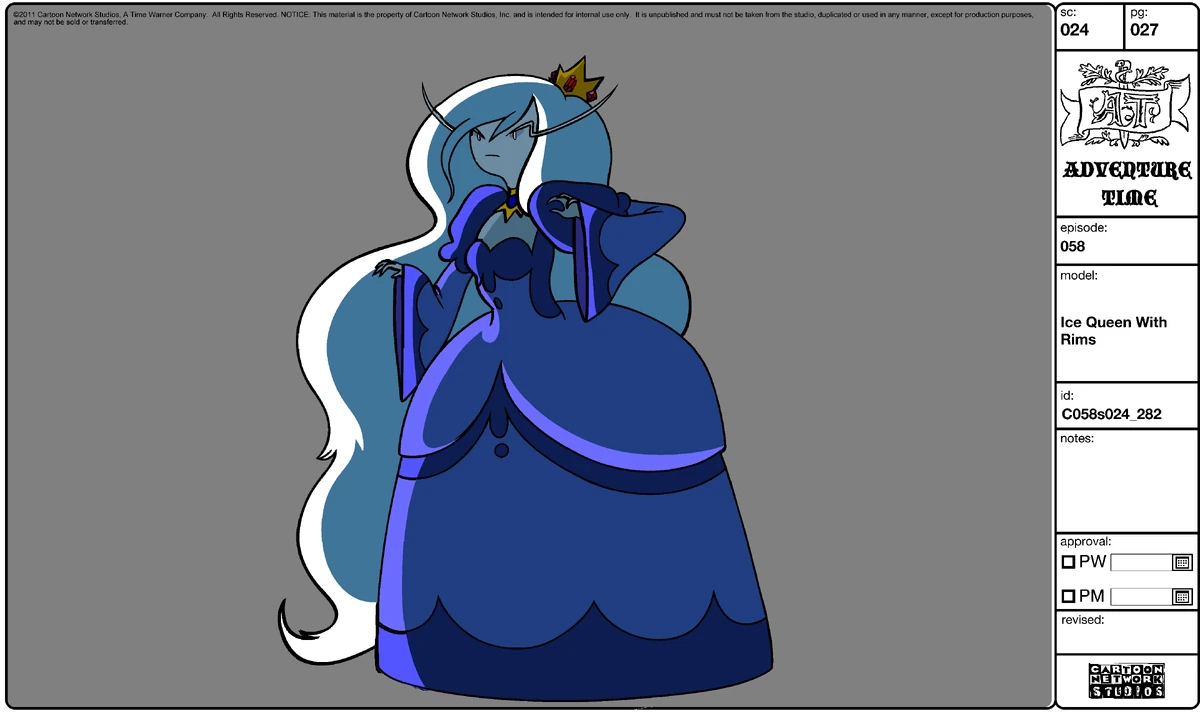
Ice Queen is weird. Honestly, if you grew up watching Adventure Time, you probably remember the first time the show flipped the script with the "Fionna and Cake" episode. It felt like a gimmick at first. A fun, one-off fanservice moment. But then things got complicated because the Ice Queen from Adventure Time isn’t just a simple palette swap of Simon Petrikov’s tragic alter ego. She’s sharper. Meaner. Maybe a little more calculated in her madness.
People usually write her off as a side note. They think, "Oh, it's just Ice King with long hair and a dress." That’s wrong. It misses the entire point of how Natasha Allegri reimagined these characters. While Ice King is a bumbling, lonely, tragic mess who just wants to be loved, the Ice Queen has this aggressive, almost predatory edge that makes her feel genuinely dangerous in a way Simon rarely does.
The Origin of the Ice Queen from Adventure Time
She didn't just appear out of thin air. In the internal logic of the show, she’s a fictional creation of the Ice King himself. Think about that for a second. The Ice Queen from Adventure Time is a manifestation of how a broken, insane old man views women—specifically, how he views a "powerful" version of himself. It’s a layer of psychological storytelling that most cartoons wouldn't touch with a ten-foot pole.
In the real world, her design came from the brilliant mind of character designer Natasha Allegri. It started as sketches on Tumblr. Fans went feral for it. Frederator Studios saw the potential, and suddenly, we had an entire sub-series. Unlike the Ice King, who wears a bulky robe to hide his thin, skeletal frame, the Ice Queen’s design is sleek. She looks like a villain from a high-fantasy novel, but she’s still fueled by that same core "crown madness" that ruined Simon’s life.
The Voice and the Vibe
Grey DeLisle-Griffin. If you know voice acting, you know that name. She’s the voice of Azula from Avatar: The Last Airbender. When she took on the Ice Queen, she brought that same "I will destroy you" energy. Ice King (voiced by Tom Kenny) usually sounds like a confused grandpa. He’s pathetic. You want to give him a hug even when he’s kidnapping princesses.
The Ice Queen is different.
She’s articulate. She’s cruel. When she fights Fionna, it doesn't feel like a misunderstanding; it feels like a grudge match. She doesn't just want to "marry" people; she wants to dominate the narrative. In the episode "Fionna and Cake," she’s actually pretending to be Prince Gumball just to lure Fionna into a trap. That’s a level of premeditated deception we rarely see from the Ice King, who usually just flies in and starts freezing things because he’s lonely.
Why the Fan-Fiction Element Matters
We have to talk about the "Fionna and Cake" episodes as a whole. They aren't "real" in the Land of Ooo—at least not initially. They are stories Ice King reads to his penguins at night. This changes how we have to view the Ice Queen from Adventure Time. She is a character within a character's mind.
Basically, she’s the Ice King’s self-insert villain.
- She is more competent than him.
- She is more attractive (by his standards).
- She is more feared.
It’s almost like Simon, buried deep within the Ice King’s subconscious, is trying to rewrite his own tragedy into something "cool" or "empowered." But because he’s insane, he just makes her a different kind of monster. This meta-narrative is why the character resonates. She’s a reflection of a reflection.
The Powers and the Crown
Does she have the same powers? Mostly, yeah. Cryokinesis is the name of the game. She can freeze the environment, create snow monsters, and fly using her hair or her cape. But the source of the power is where things get interesting in the lore. In the main Adventure Time timeline, the crown was created by the ice elemental Urgence Evergreen. It’s a "wish" crown. It grants the wearer's deepest desire, which for the original wearer (Gunther the dinosaur), was to be just like his master, Evergreen.
If the Ice Queen is a mirror of the Ice King, then her crown represents that same hijacked wish. In the 2023 Fionna and Cake spin-off series on Max, we actually get to see the "real" versions of these characters outside of Ice King’s fan fiction. We see the stakes. We see that the madness isn't gender-specific. It’s a universal decay.
How She Differs from the Ice King
If you sit down and watch "Five Short Graybles" or "Bad Little Boy," the differences become stark. Ice King is a hoarder. He keeps junk. He lives in a trash-filled castle with penguins. The Ice Queen, in the snippets we see of her world, seems to have a bit more "togetherness," even if it’s an illusion.
There's a specific sharpness to her dialogue. She doesn't ramble about "wizard eyes" as much as she taunts Fionna about her insecurities. It’s a more psychological form of villainy. Honestly, she’s kinda scary because she feels like the version of the Ice King that actually has his life—and his evil plans—under control.
The Impact on Adventure Time Lore
You can't talk about the Ice Queen from Adventure Time without mentioning the 2023 Fionna and Cake series. This show moved the characters from "fan fiction" into "multiversal reality." It’s a massive shift. We learn that Fionna’s world was a "non-magical" universe hidden inside the Ice King’s brain. When he stopped being the Ice King and became Simon again, that world lost its magic.
The Ice Queen, in this context, represents the lost magic of a dying universe. She’s the ghost of a madness that Simon Petrikov is trying to move past. It’s heavy stuff for a cartoon about a cat and a girl.
Why People Keep Coming Back to Her
Cosplay. Art. Fan theories. The Ice Queen remains one of the most popular designs in the franchise. Why? Because she represents the "What If?" factor. What if Simon hadn't been a nerdy antiquarian? What if the crown had found someone with a different temperament?
The Ice Queen from Adventure Time is a masterclass in how to do a gender-swap right. It’s not just a costume change; it’s a personality shift that stays true to the core themes of the show: loneliness, the burden of power, and the way our memories define us.
Breaking Down the "Evil"
Is she actually evil? Or is she just misunderstood like Simon?
In the episodes where she appears, she is definitely the antagonist. She freezes people. She tries to kill Fionna. She’s not "misunderstood" in the moment. However, if we accept that she is a counterpart to Simon, then she is a victim of the crown. The crown is the villain. The Ice Queen is just the vessel. It’s a nuance that makes her more than just a "monster of the week."
You see this in the way she interacts with her versions of the penguins. It’s less of a "dad" vibe and more of a "queen and her minions" vibe. It’s a subtle shift in the power dynamic that changes the entire feel of the Ice Kingdom.
Actionable Insights for Fans and Creators
If you’re a writer or a creator looking at why the Ice Queen works, there are a few things to take away. Don't just copy a character and change their gender. That's boring. Change their reaction to their circumstances.
- Vary the villainy: If the original character is bumbling, make the swap competent.
- Keep the core tragedy: The Ice Queen is still lonely, but she expresses it through rage rather than whining.
- Use the medium: Her design takes advantage of the "ice" theme in a more elegant, sharp way that reflects her sharper personality.
The Ice Queen from Adventure Time is a reminder that even in a world of candy people and magical dogs, character depth is what keeps a show alive for decades. She isn't just a gimmick. She’s a dark reflection of one of the most tragic characters in modern animation.
If you want to understand the full scope of her character, you really need to watch the 2023 Fionna and Cake series. It recontextualizes everything. It takes the "fan fiction" and makes it a tragedy about existence itself. The Ice Queen isn't just a character; she's a symptom of Simon Petrikov's broken mind, and that makes her one of the most fascinating figures in the entire Adventure Time mythos.
To truly grasp the Ice Queen, look at her transition from the original 2011 "Fionna and Cake" episode to her legacy in the spin-offs. You'll see a character that evolved from a joke into a pillars of the show's multiversal lore. Stop seeing her as a skin—start seeing her as a different side of the same coin.