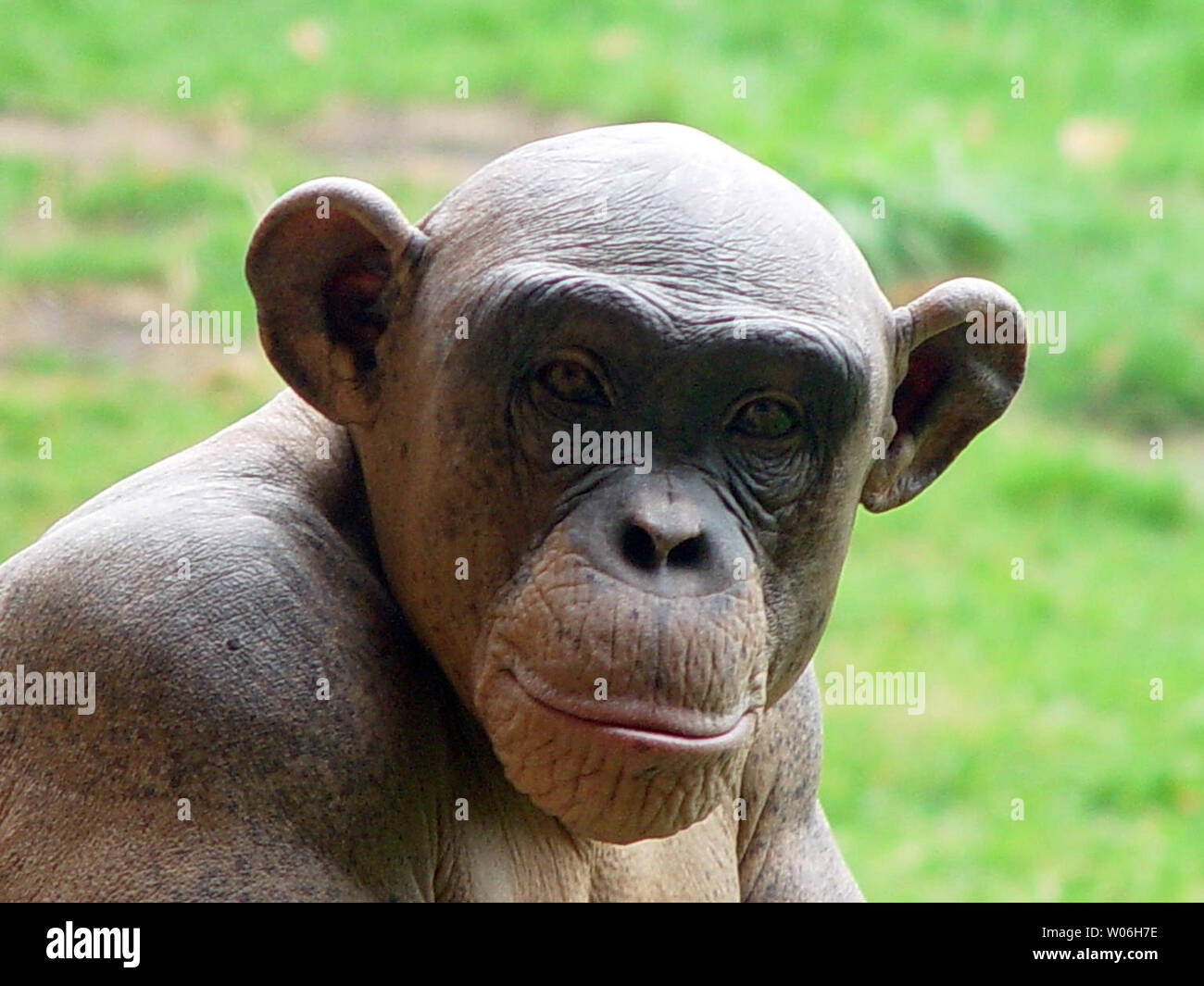
You’ve probably seen the photos. Maybe it was a blurry thumbnail on a social media feed or a high-definition shot from a zoo’s press release. Seeing a chimpanzee with no hair for the first time is honestly a bit of a shock. It’s visceral. Without that familiar coat of dark fur, the visual barrier between "animal" and "human" basically evaporates. You aren't just looking at a primate anymore; you’re looking at a muscular, intense, and strangely familiar creature that looks like it spends twelve hours a day in a CrossFit gym.
It’s jarring.
The reason these hairless chimps—like the famous Jambo or Mongo from the Twycross Zoo—cause such a stir isn't just because they look different. It’s because their lack of fur reveals the sheer, raw power hidden underneath. When you strip away the fluff, you see the anatomy. You see the deltoids. You see the traps. You see the fact that their DNA is roughly 99% identical to ours, written in every vein and muscle fiber.
What Actually Causes This?
Most of the time, when you see a chimpanzee with no hair, it isn't a new species or a weird lab experiment. It’s a medical condition called alopecia. Just like humans, chimps can suffer from alopecia areata, an autoimmune disorder where the body’s immune system gets confused and starts attacking the hair follicles.
In some cases, it’s alopecia universalis, which results in total hair loss across the entire body.
It’s not usually painful. It doesn't mean the chimp is "sick" in the traditional sense, though it can sometimes be triggered by stress or trauma. In captivity, researchers have noted that social dynamics play a huge role. If a chimp is being bullied or if they are grieving, their immune system might tank, and the hair starts falling out. But sometimes, it’s just genetics. Pure luck of the draw.
Take Guru, for example. He was a famous resident of the Mysore Zoo in India. Guru was nearly entirely bald and became a local sensation because he looked like a tiny, extremely buff human man. Keepers noted that despite his lack of hair, he lived a relatively normal life, though he was definitely more sensitive to the sun and the cold than his furry companions.
The Absolute Power of the Hairless Primate
We tend to think of chimps as cute or "monkey-like," but that’s a dangerous mistake. A chimpanzee with no hair makes it impossible to ignore how physically superior they are to us in terms of raw strength.
Biologists have known for a long time that chimps are significantly stronger than the average human. While the old "five times stronger" myth has been debunked by modern science—specifically a 2017 study by Matthew C. O'Neill published in PNAS—the reality is still intimidating. The study found that chimpanzee muscle fibers are longer and denser, making them about 1.5 times more powerful than human muscle in terms of force and velocity.
When you look at a bald chimp, you see why.
Their muscles are "bundled" differently. Because they rely on brachiation (swinging from branches) and explosive climbing, their fast-twitch muscle fibers are off the charts. You see it in their shoulders. A hairless chimp’s shoulders are massive compared to their torso size, allowing them to pull their entire body weight up a tree with a single arm. No momentum needed. Just pure, isometric strength.
The Sunburn Problem
Living without fur isn't all about looking like a bodybuilder, though. In the wild, a chimpanzee with no hair would face a brutal uphill battle for survival.
- UV Protection: Chimps live in equatorial regions. Their skin is incredibly sensitive to the sun. Without fur to act as a natural SPF, they would suffer from severe blistering and, eventually, skin cancer.
- Thermal Regulation: Fur isn't just for warmth; it’s an insulator. It keeps heat out as much as it keeps it in. A bald chimp loses its ability to regulate temperature effectively during the humid days and the surprisingly chilly jungle nights.
- Social Grooming: This is the big one. Grooming is the "currency" of chimp society. It’s how they make friends, apologize after a fight, and establish hierarchy. If you have no hair, there is nothing for your friends to groom. It can lead to social isolation or a weird shift in how the troop perceives you.
Famous Cases: Jambo and Mongo
If you've spent any time looking this up, you've probably come across Jambo and Mongo at the Twycross Zoo in the UK. They became the "poster boys" for the chimpanzee with no hair phenomenon.
Mongo, who unfortunately passed away a few years ago during a medical procedure to investigate his condition, was a massive hit with visitors. People were fascinated by his pale skin and the way his expressions were so clearly visible. Without hair framing the face, every sneer, every laugh, and every brow-furrow is magnified. You see the intelligence. You see the calculation.
It makes people uncomfortable.
We like to think there is a wide chasm between "us" and "them." A bald chimp closes that gap too quickly for comfort. You look at their hands—the fingernails, the callouses, the fingerprints—and it’s like looking into a distorted mirror.
Behavior and Interaction
Does a chimpanzee with no hair act differently?
Usually, no. Not unless the hair loss is tied to a psychological issue like "trichotillomania" (obsessive hair pulling). In some captive environments, bored or stressed chimps will pull out their own hair or the hair of their cage mates. This is a "stereotypical behavior," a sign of distress similar to pacing or rocking.
But for those with genetic alopecia, they’re just... chimps. They scream, they play, they throw things, and they hunt. Interestingly, some observers have noted that other chimps in a troop don't necessarily treat a bald chimp like a pariah. As long as the bald chimp follows the social rules and respects the alpha, the lack of fur is mostly a cosmetic issue to them. They don't have the same "uncanny valley" response that humans do.
Why We Can't Stop Staring
The fascination with the chimpanzee with no hair boils down to a concept in aesthetics called "defamiliarization." By removing one key element—the fur—the entire object becomes new and strange.
We are used to seeing primates in documentaries through a lens of "nature." But a bald chimp looks like a person in a costume, or perhaps more accurately, we look like bald chimps in clothes. It’s a reminder of our evolutionary history that we usually try to ignore.
Real Insights for the Curious
If you are ever at a sanctuary or a zoo and see a hairless primate, remember a few key things.
First, don't pity them. If they are in a reputable facility like Save the Chimps or a certified AZA zoo, they are likely receiving specialized skin care. Keepers often apply sunscreen or skin conditioners to prevent cracking and irritation.
Second, watch their movement. Forget the skin for a second and just look at the mechanics. Notice how the muscles slide under the skin. Notice the lack of a "waist"—chimps have very flared ribcages to accommodate a large digestive system needed for processing fibrous plants. It’s a masterclass in functional anatomy.
Actionable Steps for Primate Conservation
Seeing the vulnerability of a chimpanzee with no hair often sparks a desire to help. Chimps are under immense pressure in the wild from habitat loss and the bushmeat trade.
- Support Sanctuaries: Organizations like the Jane Goodall Institute or Chimp Haven provide lifelong care for chimps who can't live in the wild, including those with medical conditions like alopecia.
- Check Your Products: Palm oil production is a leading cause of deforestation in chimp habitats. Use apps like the "PalmOil Scan" to ensure your snacks aren't destroying the jungle.
- Educate Others: Spread the word that these hairless chimps aren't "monsters" or "hybrids." They are just individuals dealing with a skin condition, much like humans do.
The next time you see a photo of a chimpanzee with no hair, look past the initial shock. Look at the strength. Look at the eyes. It’s the closest you’ll ever get to seeing the "engine" of our closest living relatives. It’s not just a freak of nature; it’s a window into our own biological past, stripped of the fur that usually keeps us at a distance.