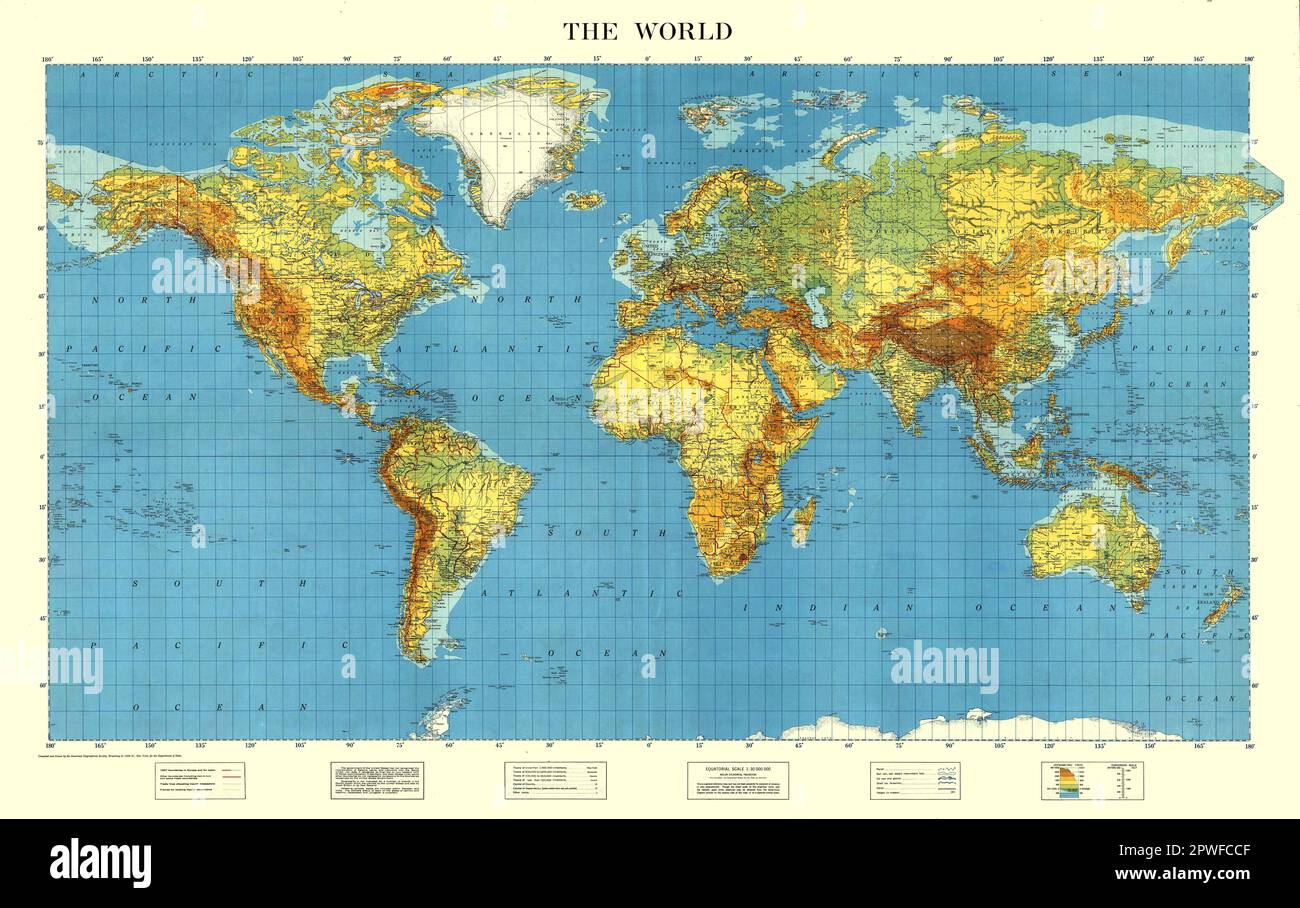
If you look at a map of the world in 1947, it looks broken. It doesn’t look like the sleek, color-coded political geography we see in modern classrooms. It’s messy. Basically, the world was suffering from a massive geopolitical hangover after World War II, and 1947 was the year the aspirin started to wear off.
The lines were moving. Fast.
Honestly, 1947 might be the most "awkward" year in cartographic history. Empires weren't just shrinking; they were collapsing in real-time. You’ve got the British pulling out of South Asia, the Dutch desperately trying to hold onto Indonesia, and the French clinging to Indochina like their lives depended on it. It’s a year of "becoming." Countries weren't necessarily countries yet—they were "mandates," "territories," or "zones of occupation." If you were a mapmaker in 1947, you probably wanted to quit your job every Tuesday.
The Year the British Empire Actually Cracked
The biggest thing you’ll notice on a map of the world in 1947 is the Indian subcontinent. For decades, it was a giant pink blob of British control. Then August happened.
Partition wasn’t just a political agreement; it was a physical tearing of the map. Sir Cyril Radcliffe, a man who had never even been to India before, was given five weeks to draw the borders for India and the new state of Pakistan. Five weeks! He used outdated census maps and old charts. The result was a humanitarian catastrophe, but on the map, it meant the birth of the Dominion of India and the Dominion of Pakistan (which included East Bengal, now Bangladesh).
If you zoom in on a 1947 map, those borders look "fresh." They don't have the settled look of ancient frontiers. They look like what they were: lines drawn in a hurry by a guy in a room who was worried about his flight home.
The British weren't just leaving India, though. They were eyeing the exit in Palestine too. In November 1947, the United Nations General Assembly passed Resolution 181. It recommended a partition of Mandatory Palestine into Arab and Jewish states. While the 1948 map is where the war-driven borders really take shape, the 1947 map shows the "Mandate" in its final, chaotic months. It’s a ghost of an empire.
Europe Was a Four-Way Puzzle
Europe in 1947 was a weird place. It wasn't "West vs. East" quite yet—that came a little later—but the cracks were forming.
Germany didn't exist as a sovereign country on the map of the world in 1947. Instead, you see the Allied Occupation Zones. The country was basically a four-layer cake of American, British, French, and Soviet control. Berlin was an island inside the Soviet zone, also chopped into four pieces. It’s fascinating to look at because these weren't meant to be permanent borders. They were "administrative lines." But as 1947 progressed and the Truman Doctrine was announced in March, those lines started feeling a lot more like walls.
Then there’s Italy. The 1947 Paris Peace Treaties fundamentally reshaped the Italian border. They lost Istria to Yugoslavia. They lost the Dodecanese Islands to Greece. It’s the year Italy became the shape we recognize today, shedding the last remnants of Mussolini’s "New Roman Empire."
- Trieste became a "Free Territory."
- The Saar Protectorate was detached from Germany and became a French protectorate.
- The Soviet Union solidified its "acquisitions" of the Baltic states (Estonia, Latvia, Lithuania), though many Western maps of the time refused to recognize it, often marking them with a disclaimer.
The Cold War Wasn't a Line, It Was a Temperature
People talk about the "Iron Curtain" as if someone went out with a giant Sharpie and drew a line across the continent. Winston Churchill gave the speech in 1946, but by 1947, the map was starting to reflect that reality through economics rather than just fences.
The Marshall Plan was introduced in June 1947. If you could color-code a map by "who is getting American money," you’d see the literal birth of Western Europe. Greece and Turkey are the big ones here. Before 1947, they were arguably in the "gray zone." After 1947, they were firmly anchored to the West. This shifted the strategic map of the Mediterranean forever.
Over in Asia, things were even more fluid. The map of the world in 1947 shows China in the middle of a brutal civil war. The Communists weren't in charge yet. If you look at a map from early 1947, the Nationalist government (ROC) still claims the whole mainland, but the red ink of Mao’s forces is spreading across the north and northeast. It’s a map in suspense.
Southeast Asia: The "No Longer" and the "Not Yet"
Indonesia is a mess on a 1947 map. The Republic of Indonesia had declared independence in 1945, but the Dutch weren't having it. In 1947, the Dutch launched "Operation Product," a massive military offensive to retake territory. So, if you’re looking at a map from that specific year, you see this weird overlap of Dutch colonial claims and Republican-held areas. It’s a "contested" geography.
French Indochina is the same story. Vietnam, Laos, and Cambodia are still technically under French control, but the First Indochina War is already raging in the jungles. Ho Chi Minh’s forces are holding significant chunks of the north.
You’ve got to realize that for people living in 1947, the map felt temporary. They’d just seen the biggest borders in the world—the Third Reich and the Japanese Empire—evaporate in a matter of months. No one expected the 1947 lines to last.
What’s Missing?
A lot.
Most of Africa is still just various shades of European colors. On a map of the world in 1947, Africa looks almost exactly like it did in 1914, with a few minor tweaks in the Italian colonies (Libya, Eritrea, Somalia), which were under UN/British administration. The wave of African independence wouldn't really hit for another decade.
In the Pacific, the Japanese Mandated Islands became the Trust Territory of the Pacific Islands, administered by the United States. It was a massive expansion of American influence across the ocean, but it was done under the "Trustee" label to make it sound less like old-school imperialism.
Why This Specific Map Still Matters
Looking at a map from 1947 explains why the world is so frustrated today. You see the roots of the Kashmir conflict. You see the origins of the Arab-Israeli conflict. You see the divide of the Koreas (the 38th parallel was already a hard line by '47).
It was the year the "New World Order" stopped being a slogan and started being a series of fences and border crossings.
The cartography of 1947 is a reminder that borders are rarely about geography. They’re about exhaustion. The European powers were too tired and too broke to keep the old maps, so they let them shatter. What we’re left with in 1947 is the debris.
Actionable Insights for Historians and Map Collectors
If you are researching or collecting a map of the world in 1947, you need to be careful about the "printing month." A map printed in January 1947 is fundamentally different from one printed in December 1947 because of the Partition of India.
- Check the Subcontinent: If India and Pakistan are distinct, the map was produced post-August. If it's one "British India," it's an early-year relic.
- Look at Germany: Examine how the "Oder-Neisse line" is drawn. Many Western maps of 1947 still showed Germany's 1937 borders with "Provisional Polish Administration" labels, reflecting the refusal to accept the new Soviet-pushed reality.
- Identify "Mandates" vs. "Trusteeships": This was the year the UN really started taking over the old League of Nations responsibilities. Maps that use the term "Trust Territory" are more "up to date" for the period than those using "Mandate."
- Verify Southeast Asian Borders: Pay close attention to the Dutch East Indies. If the map labels it "Indonesia," it’s likely a map produced by a source sympathetic to the revolution or a very late-year edition.
To truly understand this period, don't just look at one map. Compare a British-produced map of 1947 with a Soviet-produced one. The "borders" they choose to recognize tell a deeper story than the land itself. You’ll see the Cold War starting not with a bang, but with a printer's ink.