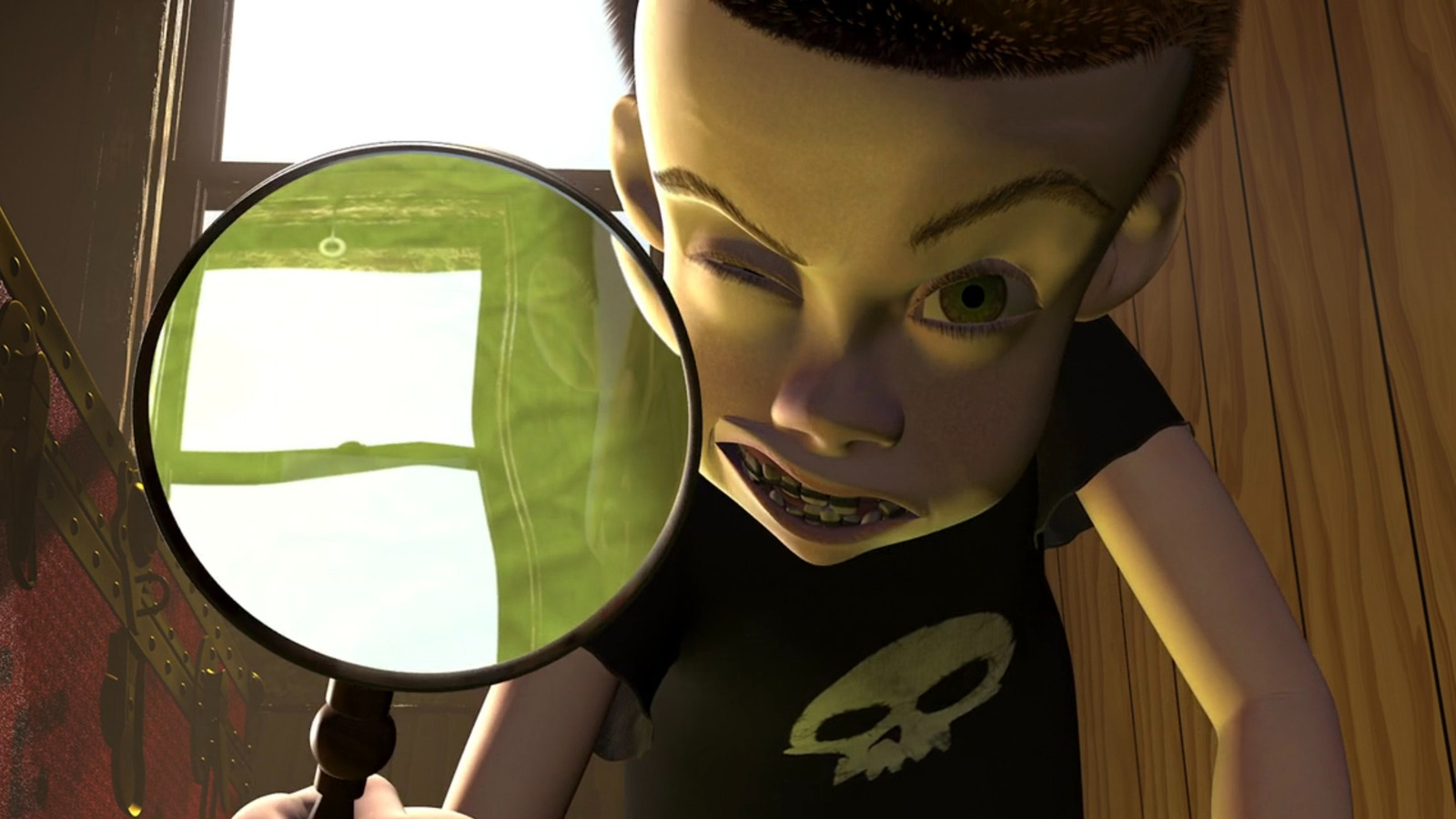
You know the look. It’s that jagged, braces-heavy beam of pure chaotic energy that flickers across the screen when a certain skull-shirted kid gets a new "delivery" from the porch. Sid from Toy Story smiling isn't just a facial expression; for an entire generation of kids who grew up in the mid-90s, it was the first time we saw a genuine antagonist find joy in destruction. It felt dangerous.
Pixar’s 1995 masterpiece changed everything about animation, but Sid Phillips changed how we viewed the "kid next door." Most people remember the explosions or the mutant toys. But if you look closer at the animation, the smile is where the real character work happens. It’s a mix of puberty-adjacent mischief and a total lack of empathy that makes your skin crawl. Honestly, it’s impressive how much personality the animators at Pixar crammed into those low-polygon facial rigs.
He’s the only human in the movie who really feels like a threat because he’s the only one who seems to be having a blast being "evil."
The Anatomy of the Scare: Breaking Down the Design
When you see Sid from Toy Story smiling, you aren't just looking at a happy kid. You’re looking at a carefully constructed nightmare. Let’s talk about the braces. In the early days of CGI, rendering metallic surfaces was a huge technical flex. By giving Sid those bulky, silver-gray braces, Pixar didn't just make him look like a typical pre-teen; they gave his smile a literal jagged edge. It looks mechanical. It looks sharp.
The lighting in Sid’s room plays a massive role here, too. Unlike Andy’s room, which is flooded with soft, warm, amber tones and "safe" primary colors, Sid’s world is all about high-contrast shadows and sickly greens. When he leans over a toy with a magnifying glass, the light catches his teeth in a way that feels almost predatory. It’s the visual language of a slasher flick disguised as a G-rated family movie.
Most people think Sid is a villain. Is he, though? Technically, he doesn't know the toys are alive. To him, he’s just a creative kid with a penchant for "extreme surgery." But that smile—man, that smile makes it hard to defend him. It’s the grin of someone who enjoys the power he has over his environment. It's about control.
Why the "Big One" Scene Hits Different
Remember the moment he receives the "Big One" rocket in the mail? The way his eyes widen and that grin stretches across his face is peak character animation. He isn't just happy; he's manic. It’s a specific kind of childhood glee that feels recognizable but slightly "off."
- The eyebrows are pushed down, creating a devious V-shape.
- The mouth is wide, but the eyes don't quite "crinkle" with warmth.
- The movement is jerky, reflecting his impulsive nature.
This wasn't an accident. Pete Docter and the original animation team spent a lot of time ensuring Sid felt like the polar opposite of Andy. While Andy’s smile is soft and open, Sid’s is tight and intense. It’s the difference between a hug and a jump scare.
What Sid’s Joy Tells Us About 90s Parenting
There’s a deeper layer to why we find Sid from Toy Story smiling so unsettling. If you look at the background details of the Phillips household, it’s a mess. You’ve got a dad asleep in a recliner surrounded by soda cans and a dog that’s clearly been conditioned to be aggressive. Sid is a product of his environment. His smile is his only way of expressing agency in a house that feels kind of depressing and neglected.
Looking back, Sid is basically the "latchkey kid" archetype dialed up to eleven. He’s unsupervised. He’s bored. He’s got a toolbox and zero guidance. When he smiles at his creations—like the infamous "Legs" or "Babyface"—he’s actually showing a weird kind of pride in his work. He’s an artist, just a very macabre one.
The Realism of the Animation
Interestingly, the technology of 1995 actually helped make Sid scarier. Because skin textures were still relatively "plastic" and smooth back then, humans often fell into the Uncanny Valley. Sid leans into this. His skin is a bit too pale, his buzzcut is a bit too uniform, and his expressions are a bit too exaggerated.
When you see a real person smile, dozens of tiny muscles move in concert. In 1995, Pixar was working with limited processing power. This meant Sid’s smiles were often "extreme" poses. That lack of subtle, fluid movement makes his joy feel robotic and unnatural. It’s one of the rare times where technical limitations actually enhanced the storytelling. It made him feel less human and more like a monster under the bed.
The Moment the Smile Fades
The climax of the film is the most satisfying "character death" that isn't actually a death. When the toys finally break the rules and reveal they are alive, the shift in Sid's face is legendary. The smile doesn't just disappear; it collapses.
- First, the jaw drops, exposing the braces in a non-threatening, shocked way.
- The pupils dilate, making him look younger and more vulnerable.
- The color seems to drain from his face as Woody tells him to "play nice."
Seeing Sid from Toy Story smiling transform into Sid being absolutely terrified is the emotional payoff the audience needs. It’s the "bully gets his comeuppance" trope, but executed with such visual flair that it stays with you. He realizes he isn't the one in control. The objects he’s been "operating" on have their own agency. It’s a total shift in power dynamics, and the animation carries every bit of that weight.
Legacy of the Skull Shirt and the Grin
Why do we still care about a kid who appeared in maybe twenty minutes of a movie thirty years ago? Because Sid represents a very specific type of childhood fear. He isn't a magical dragon or a galactic emperor. He’s the kid down the street who might actually break your favorite thing just to see how it works.
His smile has become a shorthand for "chaos." You see it on t-shirts, in memes, and even referenced in Toy Story 3 when he makes a cameo as the garbage man. Even as an adult, he’s still wearing the skull shirt. He’s still got that energy. But interestingly, in that brief cameo, he’s actually smiling and listening to music. He seems... okay? Maybe the trauma of the "living toys" incident actually chilled him out. Or maybe he just found a job where he gets to smash things legally.
The Psychology of Character Recognition
Psychologically, we are wired to detect "fake" or "malicious" smiles. Duchenne smiles (genuine ones) involve the eyes. Non-Duchenne smiles (fake or forced) are all in the mouth. Sid almost always displays a non-Duchenne smile. It’s a mask. It’s a performance of toughness.
When he’s hovering over Buzz Lightyear with that rocket, he’s performing for himself. He’s the director of his own twisted little play. That’s why the smile feels so invasive; we are witnessing his private, destructive joy.
Actionable Takeaways for Toy Story Fans and Creators
If you’re a fan of character design or just a nostalgic millennial, there are a few things to keep in mind when revisiting the "Sid era" of Pixar:
- Watch the shadows: Next time you view the film, pay attention to how Sid is lit. He’s almost always backlit or lit from below, which is a classic "villain" lighting technique.
- Compare the smiles: Look at Sid versus Andy in the opening and closing scenes. Notice how Andy’s mouth has softer curves while Sid’s has sharper angles.
- The "Sound" of the Smile: Don't forget the sound design. Sid’s laughter is high-pitched and slightly wheezy. Erik von Detten’s voice acting perfectly captures that "about to go through puberty" crack that makes the character feel even more volatile.
- Spot the Cameos: If you haven't seen the garbage man in Toy Story 3, go back and look at his shirt. It’s the same skull. The smile is different—more of a "working for the weekend" vibe—but the DNA is there.
Sid Phillips remains one of the most effective "human" villains in animation because he felt real. He wasn't trying to take over the world; he was just trying to ruin your Tuesday. And that smile? That’s the evidence of a kid who found a way to be the king of his own small, messy hill.
To truly understand the impact of the character, you have to look past the "mean kid" trope and see the technical achievement. Pixar took the limitations of 90s CGI—the hard edges, the shiny surfaces, the stiff movements—and used them to create a character that felt genuinely unnerving. Sid didn't need a monologue. He just needed to show his teeth.