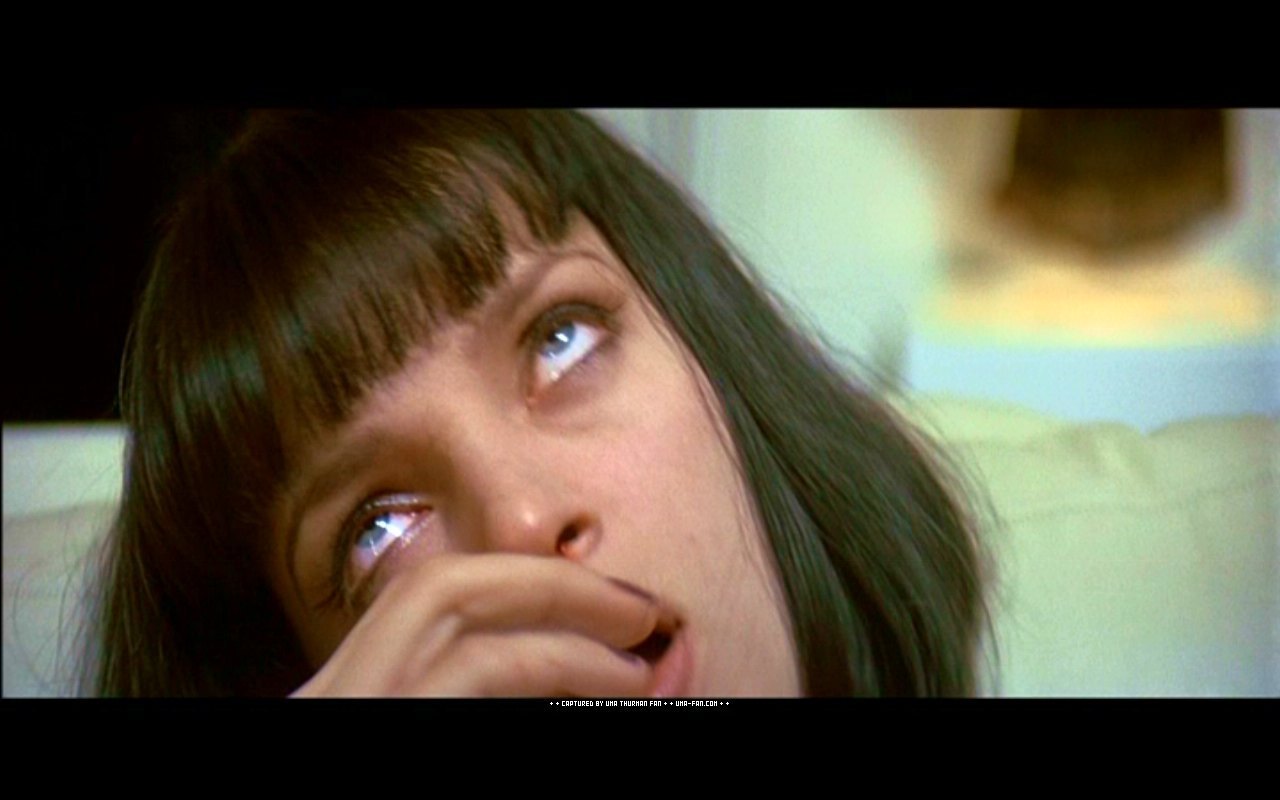
Everyone remembers where they were when they first saw it. The adrenaline. The frantic shouting. That massive needle. The Pulp Fiction overdose scene isn't just a bit of 1990s shock cinema; it’s a masterclass in tension that basically redefined how we watch movies. You’ve got Mia Wallace, played by Uma Thurman, turning blue and foaming at the mouth. Then there’s John Travolta’s Vincent Vega, a hitman who is absolutely out of his depth.
It’s messy. It’s loud. It’s terrifying.
Quentin Tarantino didn't want a clean medical drama. He wanted a nightmare.
Most people think the scene is just about the "big poke" to the heart. Honestly, though, the brilliance lies in the buildup. It starts with a simple mistake—a lethal one. Mia finds a bag of high-grade heroin in Vincent’s coat pocket. She thinks it’s cocaine. She snorts a massive "rail" of it. Because it's "Madman" heroin—way more potent than what she’s used to—her respiratory system just shuts down instantly.
The Realism vs. The Hollywood Myth
Let’s get one thing straight: if you try to perform a "precordial thump" or an intracardiac injection like that in real life without being a thoracic surgeon, you’re probably just going to kill the person faster.
In the film, Lance (played by Eric Stoltz) is the frantic drug dealer reading from a medical manual. He tells Vincent they need to hit the heart directly with adrenaline (epinephrine). While it’s true that epinephrine can be used in some cardiac emergencies, the idea of a "plunge" through the breastplate is mostly a cinematic trope. In a modern medical setting, doctors use IVs. They use Narcan (Naloxone). They don't usually go full "Captain America" on your chest with a syringe the size of a ballpoint pen.
But for the Pulp Fiction overdose scene, realism wasn't the goal. Kinetic energy was.
Tarantino actually filmed the needle entry in reverse. If you look closely, Travolta is actually pulling the needle away from Thurman’s chest. In post-production, they flipped the footage. That’s why it looks like it has so much incredible force. It’s a camera trick, but it feels like a physical assault on the viewer’s senses.
Why the Needle Scene Works So Well
It’s the silence right before the strike.
Rosanna Arquette and Eric Stoltz are screaming. Vincent is hyperventilating. Then, everything goes quiet. The camera zooms in. Vincent counts to three.
One. Two. Three! The thud of the needle hitting the chest plate is one of the most visceral foley sounds in movie history. It’s a "wet" sound. It’s heavy. When Mia bolts upright, it’s like a jump scare from a horror movie. It breaks the tension so violently that the audience finally feels like they can breathe again.
The Cultural Impact of the Red Circle
You might have noticed the red magic marker.
Lance tells Vincent he has to mark the spot so he doesn't hit a rib. This tiny detail—the shaky hand drawing a red circle on Mia’s white skin—adds a layer of "DIY" horror to the whole thing. It reminds you that these aren't professionals. They are criminals in over their heads. If Mia dies, Marsellus Wallace is going to kill them both. The stakes aren't just medical; they’re existential.
The Pulp Fiction overdose scene also served as a major comeback moment for John Travolta. Before this, he was largely seen as a "has-been" from the disco era. Seeing him panicked, sweaty, and desperate in a messy suburban house changed his career trajectory overnight.
Misconceptions About the Drug Use
Some viewers get confused about why Mia reacted that way.
Heroin is a depressant. Cocaine is a stimulant. When Mia snorts the heroin thinking it's coke, her body isn't prepared for the sudden "down." This leads to what's known as a "nod" that goes too far. Her heart rate drops. Her lungs stop moving. The "foaming at the mouth" is a real symptom—it's pulmonary edema, where fluid leaks into the lungs because the heart is failing.
Tarantino consulted with real former addicts and people who had witnessed overdoses to get the "look" of it right, even if the "cure" was pure Hollywood.
How It Changed Independent Film
Before 1994, indie movies were often seen as "talky" or slow. Pulp Fiction proved you could have high-concept dialogue and heart-stopping action in the same ten-minute span. The scene is long—nearly ten minutes from the time they arrive at Lance’s house to the time they leave. Most modern editors would try to cut that down. Tarantino lets it simmer. He makes you sit in the discomfort.
The legacy of this scene is everywhere. You see echoes of it in Trainspotting, in Breaking Bad, and in almost every gritty crime drama that followed. It stripped away the "glamour" of drug use and replaced it with a frantic search for a medical manual in a cluttered kitchen.
Actionable Insights for Cinephiles and Writers
If you’re studying the Pulp Fiction overdose scene for its technical or narrative brilliance, here is how to apply those lessons to your own understanding of media:
- Study the Sound Design: Next time you watch, turn the volume up during the silence. Listen to the floorboards creaking and the heavy breathing. Tension isn't created by noise; it's created by the anticipation of noise.
- Recognize the Reverse Shot Technique: This is a classic "low-budget" fix for a high-impact stunt. By filming the withdrawal of the needle and reversing it, the actors were kept safe while maintaining a high level of perceived "violence."
- Contextualize the Stakes: Notice how the scene isn't just about a woman dying. It's about the fear of the "boss." Every character in that room has a different motivation for wanting her to live, which creates "multi-layered" conflict.
- Differentiate Movie Magic from Reality: Always remember that cinema is about feeling, not a training manual. In a real-life emergency involving an overdose, the only "actionable" step is calling emergency services and, if available, administering Naloxone (Narcan) via nasal spray or intramuscular injection as directed by professionals.
The scene remains a pivotal moment in film history because it refuses to blink. It forces the viewer to stare at the consequence of a single, "simple" mistake, wrapped in the dark humor and high-octane energy that only 1990s Tarantino could deliver. It’s more than just a needle to the heart; it’s the heartbeat of the movie itself.