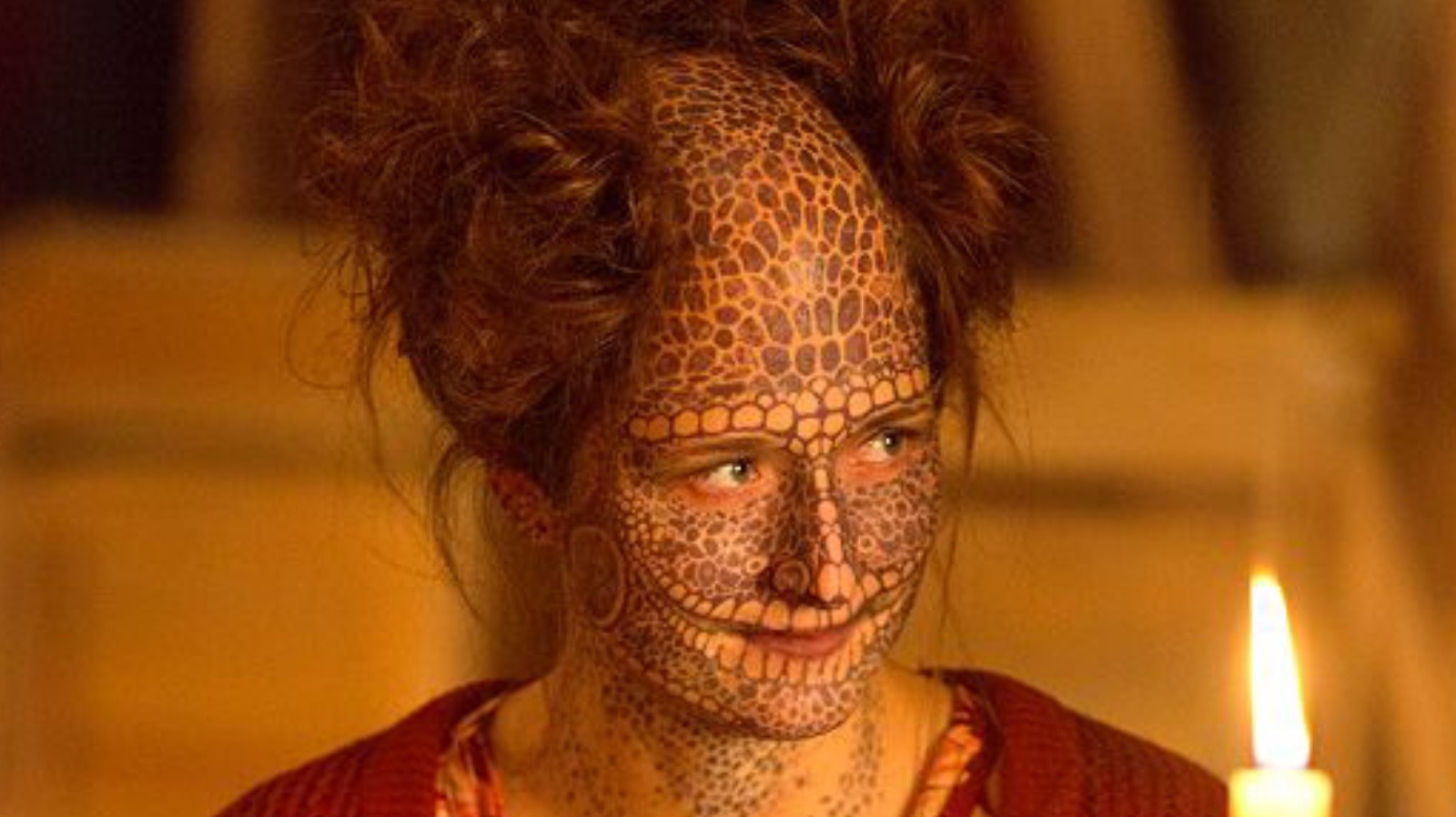
People still talk about Freak Show. Usually, it’s about Twisty the Clown’s mask or Elsa Mars’s desperate need for fame, but if you want to find the real emotional core of the season, you have to look at Penny from American Horror Story. She wasn’t a "freak" by birth. She was a candy striper. Just a regular girl who ended up entangled in a nightmare that was far more grounded—and therefore more terrifying—than any ghost or alien the series has ever cooked up.
Honestly, Penny’s arc is hard to watch.
Most characters in the AHS universe get a quick death or a supernatural upgrade. Penny got a slow, agonizing descent into a physical identity she never asked for. Grace Gummer played her with this quiet, vibrating intensity that made the eventual horror of her transformation feel like a punch to the gut. It wasn't just about the makeup effects. It was about the betrayal of a daughter by her own father.
Who Was Penny Before the Scales?
When we first meet Penny from American Horror Story, she’s working at the hospital. She's kind. She's empathetic. She meets the "monsters" of Fraulein Elsa’s Cabinet of Curiosities and doesn't recoil. That’s her "sin" in the eyes of her father, Morris. In a world of 1950s Jupiter, Florida, crossing that social line was basically a death sentence for your reputation.
She fell for Paul the Illustrated Seal. It was sweet, actually. Genuine.
But their romance wasn't a fairy tale. It was the catalyst for one of the most depraved acts of violence in the show’s history. Her father, played with a chilling, mundane evil by Andrew Duplessie, couldn't handle the "shame" of his daughter loving a carnival performer. He didn't just kick her out. He decided to turn her into what he hated most.
The Lizard Girl Transformation
The scene is burned into the brains of anyone who watched Season 4.
Penny's father hires a crooked tattoo artist. He drugs her. While she’s unconscious, he has her entire face and head tattooed with reptilian scales. Her tongue is bifurcated—split right down the middle like a snake's. It’s a permanent, indelible mark of his own hatred.
When she wakes up and looks in the mirror, she isn't Penny the candy striper anymore. She is the Lizard Girl.
This is where the writing gets interesting. A lesser show would have made her a victim forever. Instead, Penny leans into it. She realizes that the world she came from—the "normal" world—is actually the one filled with monsters. The freaks? They’re the only ones who actually give a damn about her.
Why This Arc Still Hits Hard
It’s about bodily autonomy. Or the lack of it.
The horror of Penny from American Horror Story isn't about jump scares. It’s the realization that your own family can see you as a canvas for their own insecurities. She became a permanent member of the troupe, not because she wanted to be a performer, but because her father made it impossible for her to exist anywhere else.
She eventually gets her revenge, which is one of the few moments of pure, cathartic justice in Freak Show. She and the other women of the camp corner her father. They don't kill him—they give him a taste of his own medicine. They tar and feather him. It’s brutal. It’s messy. It’s exactly what the audience wanted to see.
The Reality of "Lizard Girl" Inspiration
Ryan Murphy loves pulling from history. While Penny herself is a fictional creation, her look draws heavily from real-life sideshow history. Specifically, characters like "The Alligator Man" or "The Snake Lady" were staples of 19th and 20th-century traveling shows.
Most of those real-life performers had skin conditions like Ichthyosis, which causes the skin to thicken and scale.
In Penny’s case, the "condition" was man-made. This flips the script on the season’s central theme: Who is the real freak? The person with the physical deformity, or the person who is morally bankrupt?
- The Makeup Process: Grace Gummer reportedly spent hours in the chair for those tattoos. They weren't just simple stickers; they had to look like they were part of her skin texture.
- The Tongue: The split tongue was achieved through a mix of prosthetics and clever camera angles, though the "forked" movement was largely a visual effect.
- The Performance: Gummer’s voice changed after the transformation. She became raspier, more guarded.
Penny’s Legacy in the AHS Universe
If you look at the broad spectrum of American Horror Story, Penny stands out because she is one of the few characters who survives her ordeal with her soul somewhat intact. She doesn't become a villain. She doesn't become a ghost trapped in a house. She becomes a survivor who finds a chosen family.
She represents the bridge between the two worlds.
She knew what it was like to be "normal." She knew the privilege of walking down a street without being stared at. When that was stripped away, she didn't fold. She became the "Lizard Girl" and owned the title.
What Viewers Often Miss About Penny
Some fans argue that Penny’s story was a side plot that didn't need as much screen time. They’re wrong.
Without Penny, Freak Show is just a story about performers fighting a killer clown and a rich sociopath. With Penny, it becomes a story about the fragile boundary between "us" and "them." Her father’s actions prove that the "normal" people in the show are often the most sadistic.
Her transformation wasn't just a plot point; it was the ultimate indictment of 1950s conformity. If you didn't fit the mold, they would break you until you fit a different one.
Understanding the Symbolism
The lizard imagery isn't accidental. Lizards shed their skin.
Penny had to shed her old life, her old name, and her old expectations. It was a violent, non-consensual shedding, but she emerged as something tougher. Cold-blooded? Maybe a little bit. You’d have to be after what she went through.
Her relationship with Paul is one of the few "healthy" ones in the show. He loved her when she was a candy striper, and he loved her when she had scales. In a series defined by betrayal and toxic lust, their bond was weirdly wholesome.
Practical Takeaways for AHS Fans
If you're revisiting Freak Show or diving in for the first time, pay close attention to the sound design during Penny’s scenes post-transformation. There’s a subtle difference in how she’s lit and how she moves.
- Watch for the transition: Notice how her clothing changes from soft pastels to darker, more practical "carnie" gear.
- The Father's Fate: Re-watch the scene where she confronts her father. It's a masterclass in tension.
- Compare to other seasons: Look at how AHS treats physical transformation in Asylum (Shelley) versus Freak Show (Penny). It tells you a lot about the different "vibes" of the seasons.
Penny remains a fan favorite because she is the ultimate underdog. She didn't have powers. She didn't have a weapon. She just had the will to keep going after her world ended.
Moving Forward with the Series
If you want to understand the deeper themes of American Horror Story, stop looking at the monsters and start looking at the people who are forced to become them. Penny is the blueprint for that.
To get the most out of her story, watch the episodes "Pink Cupcakes" and "Test of Strength" back-to-back. These episodes highlight the peak of her agency and the depths of her father's depravity. It’s a harrowing watch, but it’s essential for understanding why Freak Show remains a high-water mark for the franchise's character development.
Don't just see the scales. See the girl who survived the person who was supposed to protect her. That's the real story of Penny.
The next time you see a "lizard" character in media, you'll probably think of Penny. She changed the way the show approached permanent character consequences. Usually, magic or a "reset" happens. Not for her. She lived with those marks until the end.
Analyze her choices. See how she navigates her new reality. It's a lesson in resilience, even if it's wrapped in a dark, twisted package. Penny isn't just a side character; she’s the moral compass of a world that lost its way.
Next Steps for Deep Diving into Penny’s Lore
To truly grasp the impact of Penny’s character, compare her journey to that of Shelley from Asylum. Both characters undergo horrific, non-consensual medical "procedures" at the hands of men in power. However, while Shelley’s story is a tragedy of total destruction, Penny’s story is one of reclamation.
- Research the real "Lizard Man" of the 19th century, Erik Sprague, to see how modern body modification echoes the fictional tattoos Penny received.
- Examine the 1932 film Freaks, which was the primary inspiration for this season. You’ll see the "tar and feathering" scene has deep roots in cinematic history, used as a tool for the marginalized to take back their power.
- Pay attention to the costuming in the later episodes of Freak Show. Penny’s wardrobe begins to mirror the textures of her skin, showing her eventual acceptance of her new identity within the troupe.
This isn't just about horror; it's about the social history of the "other." Penny is the bridge.