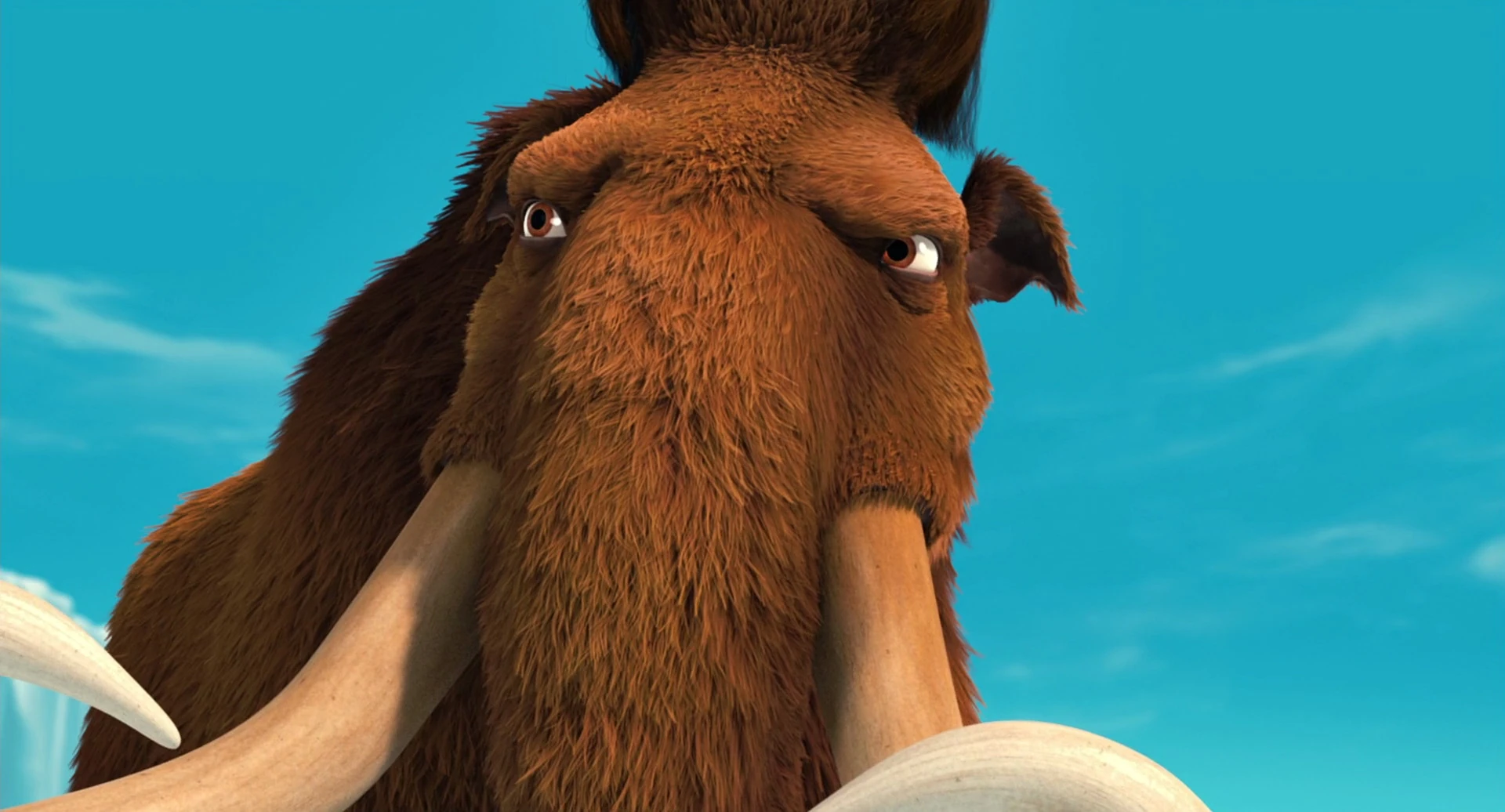
Honestly, if you grew up in the early 2000s, you probably remember the first time you saw a giant, reddish-brown woolly mammoth trudging against the grain of a massive animal migration. While every other creature was booking it south to avoid becoming a popsicle, Manfred—better known as Manny—was heading north. He didn't care about the cold. He didn't care about the "end of the world."
He just wanted to be alone.
Most people look at ice age characters manny and see the "straight man" of the comedy trio. He’s the guy who rolls his eyes at Sid’s antics and growls at Diego’s sarcasm. But if you look closer at the actual lore Blue Sky Studios built, Manny isn't just a grumpy cartoon elephant. He is a deeply traumatized survivor whose entire personality is a defense mechanism.
The Tragic Backstory Nobody Liked to Talk About
Kids usually miss the heavy stuff. I know I did. But there is a scene in the original 2002 Ice Age that changes everything. When the herd wanders into those ice caves and finds the wall paintings, the mood shifts. It stops being a road-trip comedy for a second.
Manny stares at a painting of a mammoth family. A mother, a father, and a calf. Then, the cave art shows humans—spears in hand—closing in. We see the father mammoth trying to fight them off while the mother and baby are cornered against a cliff.
It wasn't just a random history lesson. That was Manny's life.
Before he met Sid or Diego, Manny had a wife and a son. They were slaughtered by the very species he eventually spends the whole first movie trying to save. Think about that for a second. He’s protecting a human baby—the offspring of the creatures that took everything from him. That isn't just "being a good guy." It’s a massive internal struggle.
The humans in the Ice Age universe aren't just background fluff. They are the primary predators. It makes his decision to return the baby, Roshan, an act of radical forgiveness. He chooses to break the cycle of violence rather than letting a tiger eat an innocent child.
Why Ray Romano Was the Only Choice
You can't talk about Manny without talking about that voice. Ray Romano was at the height of his Everybody Loves Raymond fame when he took the role.
Actually, the casting was pretty brilliant. Romano has this specific "nasal-droning-but-endearing" quality. He sounds like a guy who’s had a long day at the office and just wants to sit in his recliner, but the recliner is a glacier and the office is a 20,000-year-long trek.
He brought a certain "New York dad" energy to the Pleistocene.
A Quick Look at the Stats
- Species: Woolly Mammoth (Mammuthus primigenius)
- Voice Actor: Ray Romano (Main films)
- Key Traits: Sarcastic, fiercely loyal, surprisingly agile for a multi-ton mammal.
- Family Status: Widowed (first family), Mated to Ellie, Father to Peaches.
The Evolution of the Grump
As the sequels rolled out—The Meltdown, Dawn of the Dinosaurs, Continental Drift, and Collision Course—Manny changed. A lot. Some fans argue he actually became too soft. In the first film, he’s a "Knight in Sour Armor." By the fifth movie, he’s basically a suburban dad worrying about his daughter’s wedding.
But there’s a logic to it.
In The Meltdown, Manny’s main conflict is the fear of being the last of his kind. He’s literally facing extinction. When he meets Ellie (who thinks she’s an opossum, which is a whole other level of weird), he isn't just looking for a mate. He’s looking for a reason to keep the species going.
His overprotectiveness toward his daughter, Peaches, in the later films is often seen as annoying. People call him a "douchebag dad" in online forums like the Loathsome Characters Wiki. But if you remember that he watched his first child get crushed by rocks, his "helicopter parenting" starts to make a lot more sense. He’s terrified of history repeating itself.
Facts vs. Fiction: Is Manny Realistic?
Let's get nerdy for a second. The real woolly mammoths were roughly the size of African elephants, standing about 10 to 12 feet tall at the shoulder.
Manny is depicted as being incredibly strong, but also surprisingly nimble. In the later movies, he’s basically doing parkour on floating ice chunks. In reality, a mammoth’s ankles probably wouldn't appreciate a "triple-flip-off-a-glacier" move.
Also, the "herd" concept is a bit of a stretch. Mammoths were social, sure. But a mammoth, a sloth, and a saber-toothed tiger hanging out? That's strictly Hollywood. In the real Pleistocene, Diego would have been trying to figure out how to take Manny down, not helping him babysit.
Interestingly, paleontologists have found evidence in places like New Mexico of human footprints, mammoth tracks, and giant sloth tracks all in the same mudplain. They weren't "friends," but they were definitely sharing the same space.
What Most People Get Wrong About Manny
There’s this common misconception that Manny is just "the boring one."
People love Sid because he’s funny. They love Scrat because he’s chaotic. They love Diego because he’s cool.
But Manny is the anchor. Without him, the herd doesn't exist. He is the one who provides the physical protection and the moral compass. He’s the one who decides that "that’s what you do in a herd—you look out for each other."
He basically invented the concept of "found family" for an entire generation of kids before it became a trendy trope.
The "Flanderization" Problem
Honestly, the later movies did him a bit dirty. By the time we get to Collision Course (the one with the asteroids and the purple crystals), Manny’s personality is spread pretty thin. He becomes a bit of a caricature of a bumbling husband.
If you want the "real" Manny, you have to go back to the first three films. That’s where the character arc actually lives. That’s where you see a grieving father slowly learn how to love again.
Why He Still Matters in 2026
It’s been over twenty years since the first movie hit theaters. Yet, we’re still talking about these characters. Why? Because Manny represents something universal: the idea that your past doesn't have to define your future.
He lost everything. He had every reason to be a villain or a hermit. Instead, he chose to let a clumsy sloth and a suspicious tiger into his life.
If you're looking to revisit the series, pay attention to the silence. The moments where Manny isn't talking. That’s where the best character work happens.
Next Steps for Fans:
- Watch the Cave Painting Scene: Go back and re-watch the original Ice Age cave scene. It hits way harder as an adult.
- Check the Science: Look up the "White Sands footprints" discovery. It’s the closest thing we have to a real-life version of the movie’s animal-human crossover.
- Skip the Spinoffs: If you want the core Manny experience, stick to the first trilogy. The emotional weight is much more present there.
Manny isn't just a big pile of fur and tusks. He’s a reminder that even the grumpiest among us are usually just people (or mammoths) who have been through a lot and are just looking for a "herd" to call home.