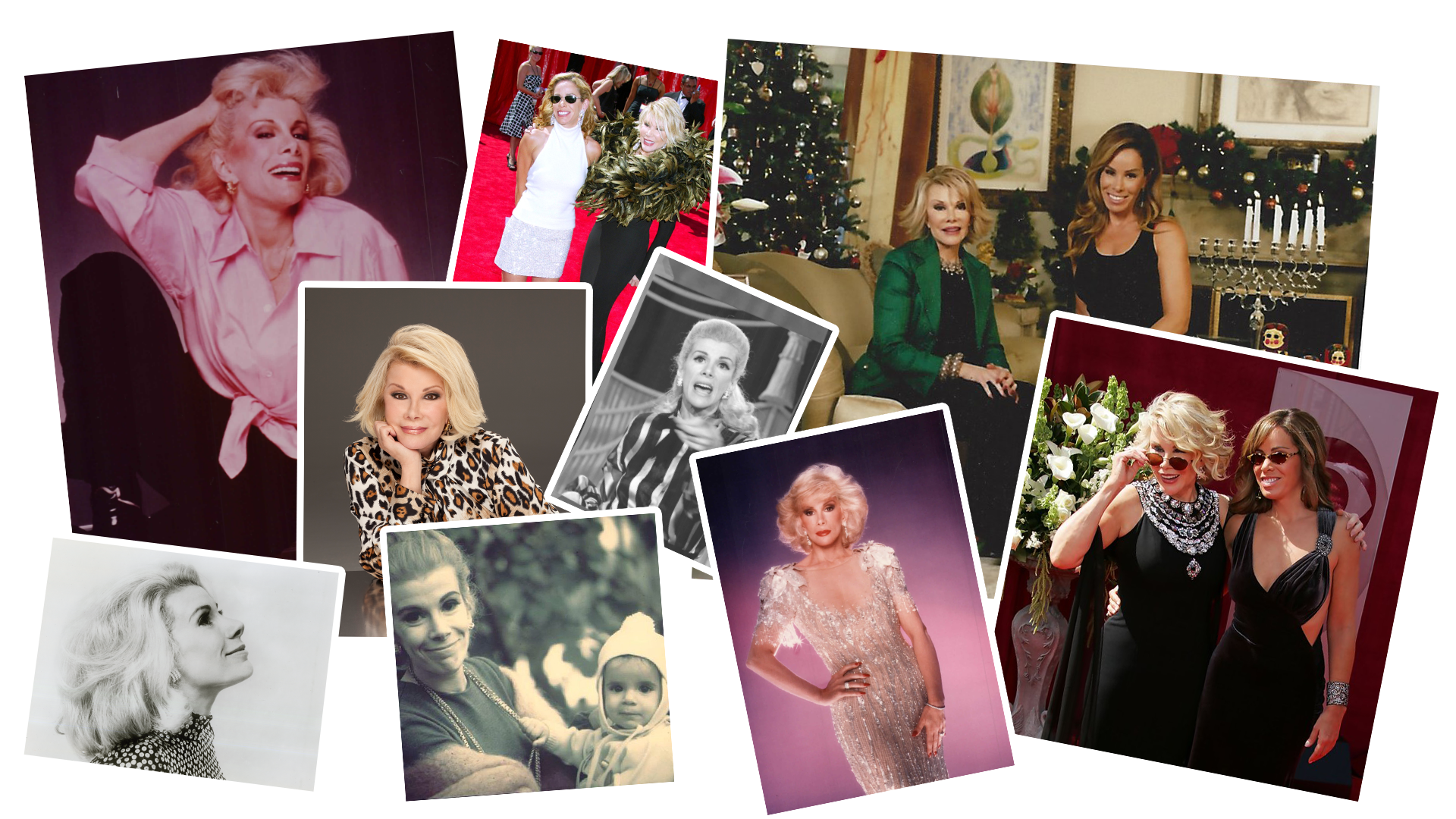
Joan Rivers was a lot of things. A pioneer. A loudmouth. A woman who probably had more plastic surgery than some medical textbooks. But if you really look at Joan Rivers outfits over the last few decades of her life, you’ll see something most people missed while they were busy laughing at her jokes. The woman was a tactical genius of fashion.
She didn't just wear clothes; she wore armor.
Whether she was standing on a windy red carpet at the Oscars or hawking "Classics" on QVC at 3:00 AM, Joan understood the visual language of power. She knew that a woman of a certain age—especially one who made a living being "difficult"—needed to look expensive, sharp, and utterly untouchable. Honestly, her style evolution is a masterclass in how to stay relevant when the world is trying to age you out.
The New York Makeover and the David Dangle Era
In the early days, Joan was very "California." Think huge hair, massive shoulder pads, and those Galanos dresses that screamed 1980s wealth. It was fine, but it wasn't her.
Everything changed when she met David Dangle. Dangle, an Emmy-winning costume designer, became her right-hand man and eventually the CEO of Joan Rivers Worldwide. He basically staged an intervention. He told her she needed to drop the West Coast glitz and embrace a "New York" sensibility.
The result? The birth of the Joan Rivers we all remember.
The transformation wasn't about dressing younger. It was about dressing better. She pivoted to a uniform of sleek black columns—usually a simple tank and narrow trousers—layered under what she called "statement jackets." These weren't just coats. They were works of art covered in sequins, feathers, and intricate embroidery. They provided the "pop" she needed for television while the black base kept her silhouette streamlined.
Why the "Column of Color" Worked
Joan used a trick she learned from old-school Hollywood legends like Gloria Swanson. Swanson told her to always taper her skirts and pants. If the bottom of a garment is slightly narrower than the hips, it creates a more graceful, slender line. Joan took this to heart. You’ll notice in most Joan Rivers outfits from the late 90s onward, she almost always wore slim-leg pants. It prevented her from looking "frumpy" under those voluminous fur coats and capes she loved.
The Red Carpet: "Who Are You Wearing?"
We take it for granted now, but Joan and her daughter Melissa basically invented the modern red carpet pre-show. Before them, reporters asked actors about their "process." Joan showed up and asked, "Who are you wearing?"
The New York Times actually mocked her for it. They said it was improper grammar and that nobody cared about the clothes.
They were wrong.
Joan realized that the red carpet was a "ruthless meritocracy." She viewed it as a business transaction: designers give stars free clothes, and stars provide the advertising. Because she understood this, her own red carpet looks were always calculated. She rarely wore "trendy" pieces. Instead, she leaned into:
- Massive Statement Jewelry: Usually from her own collection, proving she was her own best billboard.
- Feather Boas and Capes: She loved the drama. She knew a 5-foot-2 woman needed to take up space physically to command the room.
- Chanel and Oscar de la Renta: She had the money, and she spent it on pieces that held their value.
The QVC Empire: Bringing the Look to the Masses
It’s easy to forget that Joan was a billionaire-level business mogul. Her QVC line, the Joan Rivers Classics Collection, started in 1990 with jewelry and expanded into clothing by 2007.
She didn't just put her name on junk. She was obsessive about the "swing" of a shirt. She popularized the "Boyfriend Shirt"—a relaxed, button-down tunic that covered the hips but still looked tailored. It was a staple for women who wanted to look put together without being uncomfortable.
Her jewelry was heavily inspired by her own collection of Fabergé and vintage pieces. She wanted "fake" jewelry that looked "real." After her death, her private collection sold at Christie's for millions. A single Fabergé frame went for $245,000. But on QVC, you could get a "Faber-style" bee brooch for under fifty bucks. She understood that every woman wanted a piece of that "uptown" life.
The Pieces That Defined Her
If you want to recreate the essence of Joan Rivers outfits, you have to look at her "Greatest Hits." These weren't just items; they were her signature.
The Statement Blazer
Joan was rarely seen without a jacket. Her favorites were often heavily embellished with sequins or made of rich metallic brocade. She used these to draw the eye upward toward her face, which was always perfectly made up.
The Bee Brooch
The bee became her unofficial mascot. She famously said that aerodynamically, a bee shouldn't be able to fly, but it does anyway. It was a metaphor for her career. She wore bee pins on her lapels, her hats, and even her bags.
The Fur (and Lots of It)
Joan didn't care about being "politically correct" when it came to her wardrobe. She loved fur. Huge sable coats, fox stoles, and mink trims. To her, fur represented the ultimate "I’ve made it" status symbol of her generation.
How to Apply the Joan Rivers Style Logic Today
You don't have to wear a floor-length feathered cape to get the Joan Rivers look. Her style was built on a few solid rules that still apply to anyone wanting to look more polished:
- Build a Base: Start with a "column of color"—all black, all navy, or all cream. It’s an instant slimming effect.
- Invest in the "Third Piece": A great outfit is usually a top and a bottom, but the "third piece" (a blazer, a cardigan, or a bold scarf) is what makes it fashion.
- The Taper Trick: Have your tailor take in the bottom of your skirts or trousers by just half an inch. It creates a much cleaner line.
- Go Big on Accessories: If your clothes are simple, your jewelry should be loud. Joan loved a multi-strand pearl necklace or a "look-at-me" cocktail ring.
- Confidence is the Final Layer: Joan wore some truly wild things (remember the 1990s gown with the eye patch?), but she never looked unsure of herself.
Joan Rivers used fashion to tell the world she was still here, still wealthy, and still the funniest person in the room. Her outfits were a loud, sequined "f-you" to anyone who thought a woman her age should fade into the background.
If you're looking to upgrade your own wardrobe using Joan’s principles, start by looking for a high-quality "statement" blazer or a versatile tunic. Focus on structure and fit rather than following every passing trend. Building a "signature look" like Joan did takes time, but it’s the best way to ensure you always feel like the best version of yourself when you walk out the door.