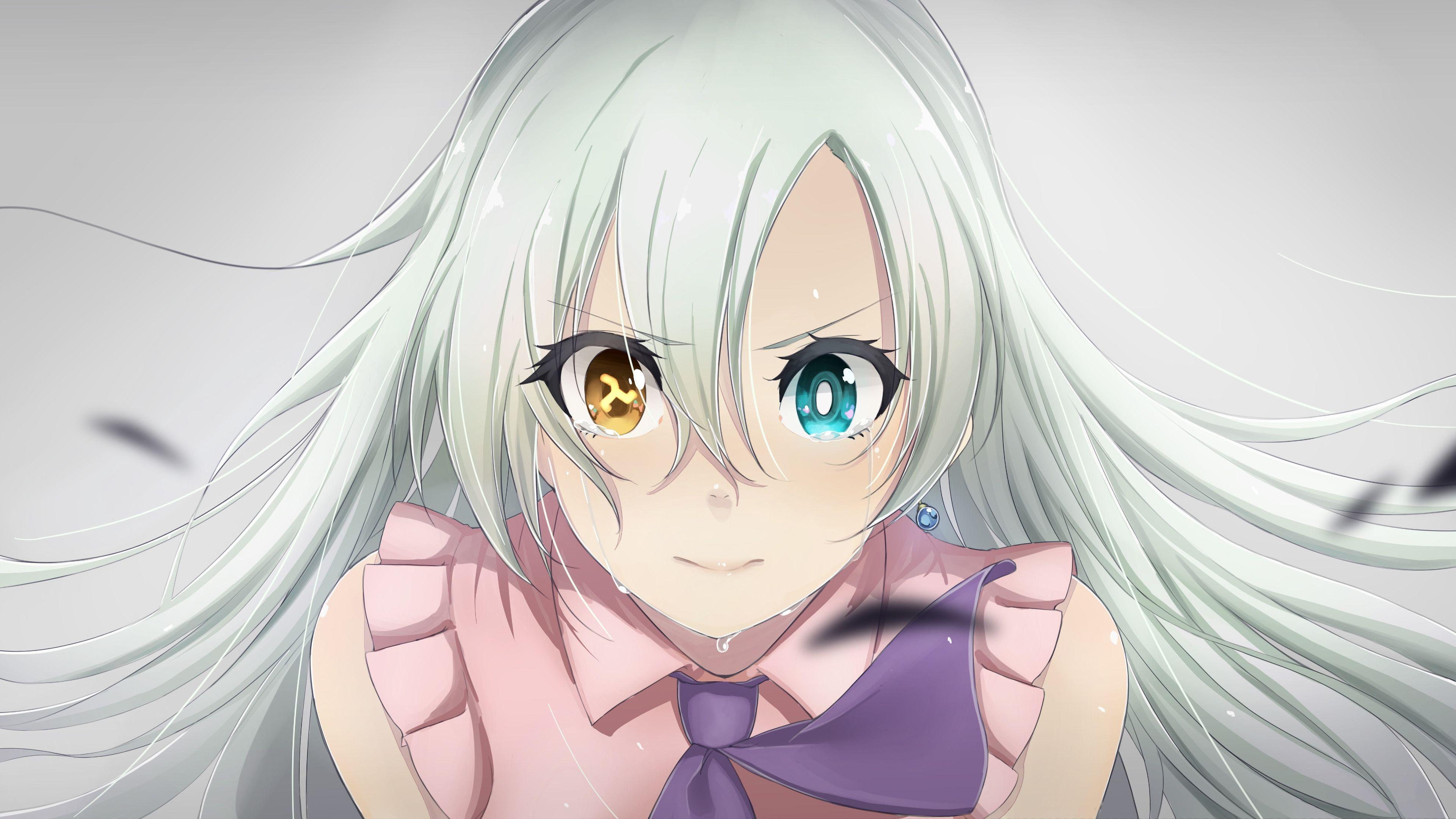
If you’ve spent any time in the anime community over the last decade, you’ve seen her. The silver hair, the mismatched eyes, the constant "Meliodas-sama!" calls. Honestly, at first glance, Elizabeth Liones seems like the ultimate blueprint for the "damsel in distress" trope. She starts the series falling into a tavern in a rusty suit of armor, looking for heroes to save her kingdom. It’s classic. It’s almost too classic. But if you actually stick with Seven Deadly Sins (Nanatsu no Taizai) past the first season, you realize Elizabeth is probably the most tragic, complicated, and weirdly powerful character Nakaba Suzuki ever drew.
People get her wrong. They think she's just the emotional anchor for Meliodas, the guy with the broken sword and the scary demon powers. That’s a massive oversimplification. To understand Elizabeth from Seven Deadly Sins, you have to look at the "Eternal Reincarnation" curse. It’s not just a plot device; it’s a psychological horror show that defines every single thing she does.
The 107 Lives of Elizabeth Liones
The big twist—the one that recontextualizes the whole show—is that Elizabeth isn't just a princess of Liones. She’s the 107th reincarnation of the Goddess Elizabeth. Think about that for a second. While most characters are fighting for their lives in the present, Elizabeth is a cosmic casualty of a war that ended 3,000 years ago.
She was the daughter of the Supreme Deity. She fell in love with the son of the Demon King. In any other shonen, that’s a "Romeo and Juliet" backstory. Here? It’s a death sentence. Because they dared to love across enemy lines, they were cursed. Meliodas got immortality—he can’t die, and if he does, he just comes back with less of his soul. But Elizabeth? She was cursed to die and be reborn as a human over and over.
The kicker is the "Three Day Rule."
Every time she regains her memories of her past lives and her goddess powers, she dies exactly three days later. Usually right in front of Meliodas. It’s brutal. She’s lived as a tribal girl, a knight, a peasant, and finally, the third princess of Liones. When you see her crying in the early episodes, it feels like typical anime melodrama. Once you know the lore, those tears feel a lot heavier. She’s subconsciously mourning thousands of years of failure.
Why the Goddess Clan Logic Matters
In the world of Seven Deadly Sins, the Goddess Clan isn't "good" in the way we usually think. They’re kind of terrifying. They’re manipulative, they view humans as pawns, and they’re just as bloodthirsty as the demons they fight. Elizabeth was the outlier.
She wasn't just a pacifist because she was "nice." She was a rebel. In the Holy War 3,000 years ago, she used her "Ark" abilities and "Let There Be Light" not just to kill, but to purify and negotiate. She earned the nickname "Bloodstained Ellie" before she turned toward peace, which is a detail a lot of casual fans miss. She had the capacity for extreme violence. She chose to put it down.
When you look at her power scaling, it’s actually insane. Even in her human form, once her eye changes—the one with the goddess symbol—she can stand toe-to-toe with Commandment-level threats. She’s one of the few characters who can actually heal entire armies or neutralize the "Miasma" of the demon realm.
The Power Dynamics of Liones
Growing up as the adopted daughter of King Bartra, Elizabeth was always the odd one out. Margaret and Veronica are her sisters, sure, but she always felt a pull toward something else. Her relationship with her "father" is actually one of the more grounded parts of the show. Bartra knew. He has the "Vision" ability, so he saw the tragedy coming.
Imagine raising a daughter knowing she’s a reincarnated deity destined to die a horrific death if she ever remembers who she is. It explains why the Liones family was so protective, yet so willing to let her go when the Sins arrived. They knew they couldn't stop destiny.
The Controversies: Fan Service vs. Character Depth
We have to talk about it. The early seasons of Seven Deadly Sins are notorious for Meliodas’s "groping" and the constant fan service involving Elizabeth. In 2026, looking back at these tropes, they haven't aged particularly well.
A lot of viewers dropped the show because of how Elizabeth was treated in the first 20 episodes. It’s a shame, honestly. If you can get past the cringe-inducing "gag" humor of the early 2010s, you see a woman who is incredibly resilient. Elizabeth isn't a victim of Meliodas; she’s his partner in a 3,000-year-old trauma bond.
When she finally gets her memories back in the "Revival of the Commandments" arc, her personality shifts. She becomes firmer. She stops being the girl who follows and starts being the woman who leads. She stares down the Demon King. She tells Meliodas, quite bluntly, that she’d rather die in three days as herself than live a hundred years as a hollow shell. That’s growth.
Breaking Down Her Abilities
Elizabeth isn't just a healer. While her "Breath of Bless" can supercharge someone's fighting spirit (basically a magical steroid), her offensive capabilities are top-tier.
- Ark: The standard goddess ability that disintegrates darkness with light particles. She can make massive spheres of this stuff.
- Healing: It’s not just "fixing a cut." She can regenerate entire limbs and purge magical poisons that would kill a regular Holy Knight.
- Flight: Those wings aren't just for show. They represent her divinity returning.
- Empathetic Connection: This is her real "superpower." She can talk down Indura—monsters of pure destruction—by connecting with their residual soul.
The Four Knights of the Apocalypse Connection
If you think Elizabeth’s story ended when the original manga did, you’re missing out. The sequel, Four Knights of the Apocalypse, shows her in a new light: Queen Elizabeth of Liones.
She’s a mother now. Her son, Tristan, is a hybrid of a Goddess and a Demon. Seeing Elizabeth navigate the politics of a post-war world while trying to protect a son who inherits the most volatile powers in existence is fascinating. She’s no longer the teenager in the tavern. She’s the matriarch of a kingdom, and she carries herself with a grace that feels earned after 107 lifetimes of misery.
Common Misconceptions About Elizabeth
- "She’s weak." Absolutely false. By the end of the series, she is arguably one of the top five strongest characters. She just hates fighting.
- "She only loves Meliodas because of the curse." The curse actually makes them miserable. The love existed before the curse; that was the whole reason they were punished.
- "She’s a reincarnation of Liz." Technically, yes. Liz (the knight from Danafor) was the 106th reincarnation. Every "Elizabeth" Meliodas met over 3,000 years was the same soul.
Why She Matters Now
Elizabeth from Seven Deadly Sins represents a specific kind of strength that often gets dunked on in shonen anime: the strength of persistence. It’s easy to be strong when you’re a fireball-spitting demon. It’s hard to stay kind when you’ve been murdered 106 times and watched your lover go insane with grief every single time.
Her agency is what defines the final act of the story. She stops being a prize to be saved and starts being the architect of the curse’s destruction. She’s the one who eventually pushes for the "true" end to the Holy War, realizing that neither the Goddesses nor the Demons can be allowed to rule.
How to Truly Experience Her Story
If you're looking to revisit her arc or jump in for the first time, don't just watch the anime. The animation quality in the later seasons (especially the infamous Season 3/4 shift) did a massive disservice to her big moments. The manga art by Nakaba Suzuki is where her power and emotion actually land.
Check out these specific points in the story to see her at her best:
- The Druid Training Arc, where she tries to grow a flower from a dead branch. It’s a metaphor for her entire existence.
- The Flashback to the Original Holy War. Seeing the "original" Elizabeth interact with Ludociel and the Archangels shows her status as a royal rebel.
- The Final Fight against the Demon King, where she finally uses her goddess powers without hesitation.
Elizabeth Liones is a masterclass in the "Long Game" of character development. She starts as a trope and ends as a legend. Whether you love the show or hate the tropes, you have to respect the sheer endurance of a character written to die, who eventually decided she’d had enough of destiny.
To get the most out of her character arc, focus on the manga chapters covering the Memories of the Holy War arc (Chapters 200-215). This is where the fluff is stripped away and you see the tactical, powerful, and deeply defiant version of Elizabeth that the first season only hinted at. Avoid the "Cursed by Light" movie until you've finished the main series, as it contains massive spoilers regarding her relationship with the Supreme Deity that reframe her entire childhood in Liones.