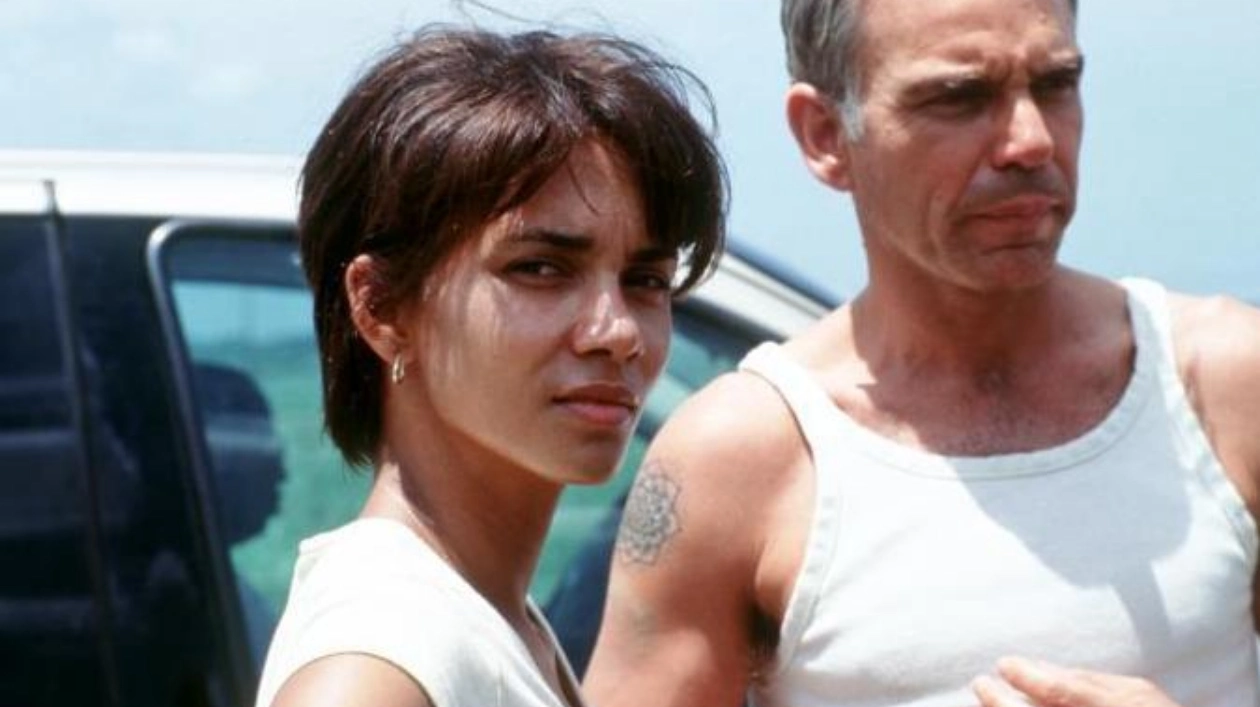
Hollywood loves a good myth. Especially when it involves a dark room, a closed set, and two actors who look like they’re having a breakdown on camera. When people talk about Billy Bob Thornton and Halle Berry, they aren’t usually talking about their lunch orders on the set of the 2001 film Monster’s Ball. They’re talking about that scene.
You know the one.
The graphic, uncomfortable, and raw sequence that supposedly "blurred the lines" between acting and reality. For over twenty years, the internet has practically insisted that the two stars weren't just acting. It became a piece of cinematic urban legend, whispered about on message boards and tabloids alike. But honestly? The reality of their relationship and what happened behind the scenes is way more interesting than the gossip.
The Performance That Broke the Academy
Before we get into the rumors, we have to look at the stakes. 2001 was a weird year for movies. Halle Berry was mostly known for being "the pretty girl" in blockbusters like X-Men or Swordfish. People forget she actually had to fight to get the role of Leticia Musgrove. The director, Marc Forster, reportedly thought she was too beautiful for the part.
She had to prove she could be "ugly." Not physically, but emotionally.
Leticia was a woman drowning in grief. She loses her husband to the electric chair, her son to a hit-and-run, and her house to an eviction notice. It’s a brutal arc. Enter Billy Bob Thornton, playing Hank Grotowski—a racist prison guard who literally helped execute her husband.
It’s a messed-up premise.
The movie works because these two characters are both at rock bottom. They aren't "falling in love" in a Hollywood way; they’re clinging to each other like drowning people. When Berry won the Oscar for Best Actress in 2002, she made history. She was the first Black woman to ever win that category. She’s still the only one. That’s a heavy legacy for one movie to carry.
Addressing the Billy Bob Thornton and Halle Berry "Urban Legend"
Let’s talk about the elephant in the room. The sex scene.
It was explicit. It was long. It felt dangerously real. Because of that, a rumor took hold that it was real. People swore they were "really doing it."
Halle Berry finally addressed this head-on recently on Dax Shepard’s Armchair Expert podcast. She basically called it a total urban legend. She admitted the rumor had "secretly driven her mad" for decades. According to her, the set was professional, and the idea of actual intimacy was off the table for a very specific reason: Billy Bob was married to Angelina Jolie at the time.
"I'm a girl's girl," Berry said. "I know Angie and she ain't signing off on that sh*t."
Billy Bob has been just as dismissive over the years. He’s often pointed out that they’re just actors doing their jobs. On Sway in the Morning, he joked about it but stayed firm on the fact that they were professionals. It’s funny how people want to believe the scandal more than they want to believe the talent. They were so good at portraying desperation that we assumed they had to be actually hooking up.
Why the Movie Still Makes People Uncomfortable
Monster's Ball isn't a "feel-good" movie. It’s messy.
Some critics have argued that the film falls into the "white savior" trope, where the white male lead (Thornton) gets a redemption arc by helping a suffering Black woman. Others think it fetishizes Black pain. It’s a valid conversation. The film doesn't give Leticia much of a voice outside of her trauma.
But if you look at the performances, there’s a nuance there. Billy Bob Thornton plays Hank as a man who is essentially a hollow shell. He’s been raised on his father’s (Peter Boyle) hatred, and it’s only when his own son (Heath Ledger) dies that the shell cracks.
The chemistry between Thornton and Berry wasn't about romance. It was about shared misery.
A Quick Look at the Production
- Budget: Only $4 million.
- Filming Location: Louisiana State Penitentiary (Angola).
- The Ledger Factor: A young Heath Ledger played Thornton’s son. Thornton actually hit Ledger during one scene because Heath asked him to make it feel real.
- Payday: Both actors took huge pay cuts because they believed in the script.
Life After the Ball
After the 2002 Oscars, their paths diverged in massive ways. Halle Berry became one of the highest-paid women in Hollywood. She went from Monster's Ball to being a Bond Girl in Die Another Day. She’s had a wild ride—from winning a Razzie for Catwoman (and showing up to accept it with her Oscar in hand!) to directing her own films like Bruised.
Billy Bob Thornton stayed in his lane of being a character actor's character actor. He did Bad Santa, Fargo, and more recently, the show Landman. He’s always been a bit of a Hollywood outsider. He doesn't really do the "celebrity" thing. He's more likely to be found in a recording studio than on a red carpet.
The bond between Billy Bob Thornton and Halle Berry remains a snapshot of a specific moment in cinema history. It was a time when mid-budget, gritty dramas could still dominate the cultural conversation.
What You Can Learn from Their Collaboration
If you're a film buff or just someone interested in the mechanics of Hollywood, there are some real takeaways here.
- Professionalism is a Shield: Despite the intense rumors, both actors maintained their reputations by sticking to the truth and respecting boundaries.
- Taking Risks Pays Off: Berry was told not to take the role. She did it anyway, and it remains the defining moment of her career.
- Chemistry Isn't Always Romance: Sometimes the best "chemistry" on screen is just two people being incredibly vulnerable and honest with the material.
If you haven't seen the movie in a while, it's worth a re-watch—not for the gossip, but to see how two actors at the top of their game handled some of the darkest themes imaginable. Just don't expect a happy ending. It's not that kind of story.
To dig deeper into this era of film, you should look into the "Indie Boom" of the early 2000s and how producers like Lee Daniels changed the game for minority representation in prestige cinema. You might also find it interesting to compare Berry’s win to the lack of Black Best Actress winners in the twenty years since—it's a gap that still sparks huge debate in the industry today.